The singing roofs
Roof moths graze glowing lichen and produce silk that warms when someone sings near it.
The Last Ink · world atlas · draft 2
Above, a lively magical coast believes its war with devils is over. Below, a concealed inhabited world survives among the lost roads of an ancient shared civilisation. Surface springs are failing while hidden streets flood; people above do not know their ordinary water works can affect anyone below. A corruptor has found a way to counterfeit old passage commands and intends to turn that ignorance into another war.
All new lore, names, maps, mechanics and illustrations are proposals. The foundation is Chapter 1 and the Chapter 2 entrance you liked. Later chapter explorations do not establish canon.
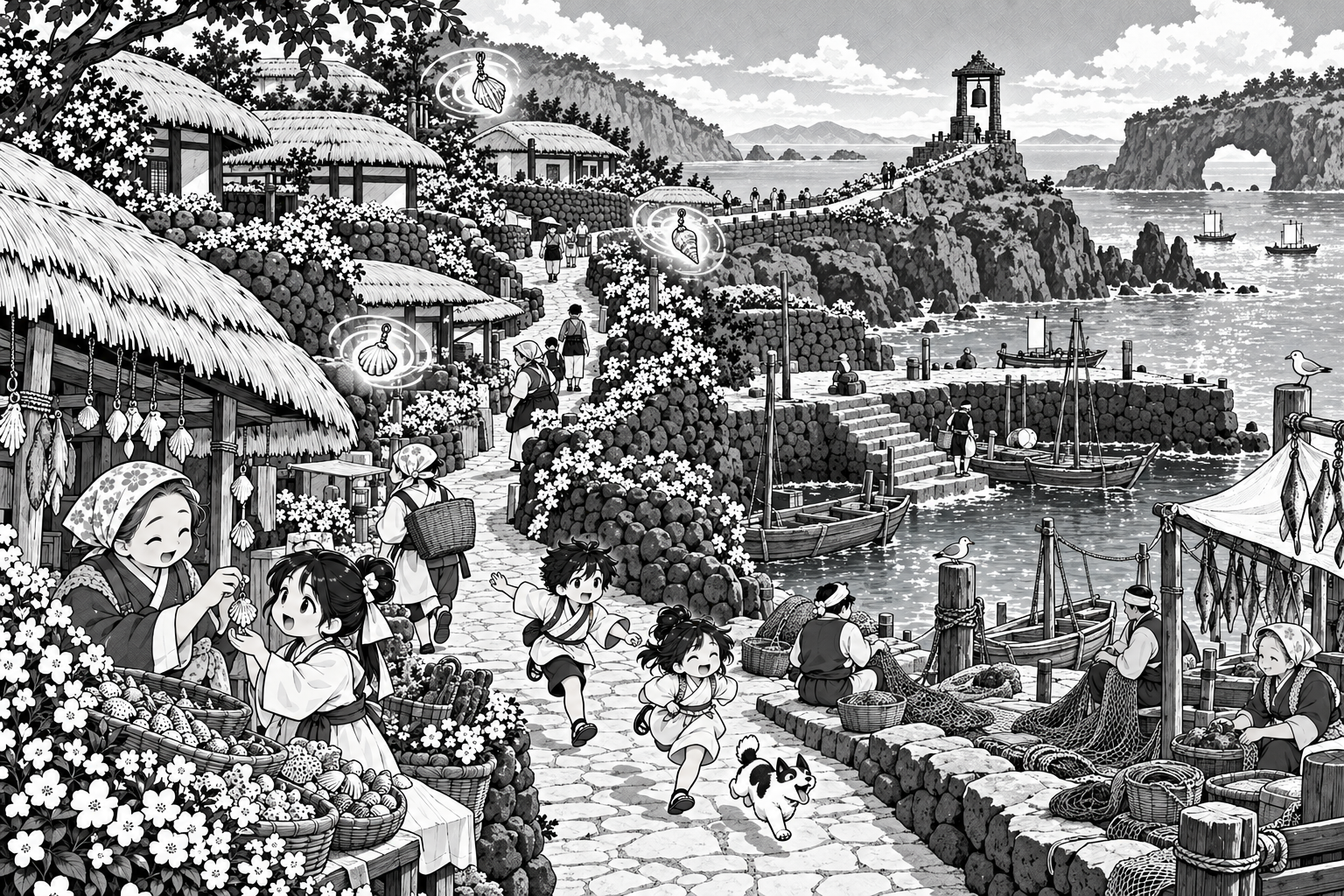
peace
There is room to be young. Sumbi can want a reef excursion and Meok can practise a ridiculous reach trick while a courier boasts about beating her own time. Neighbours plan a festival, argue about food and worry about harvests more often than invasion.
Roof moths graze glowing lichen and produce silk that warms when someone sings near it.
Stone orchard fruit ripens inside protective shells that open to the correct tapping rhythm.
Shell-message games let children send a short sound around a courtyard, with embarrassing mistakes.
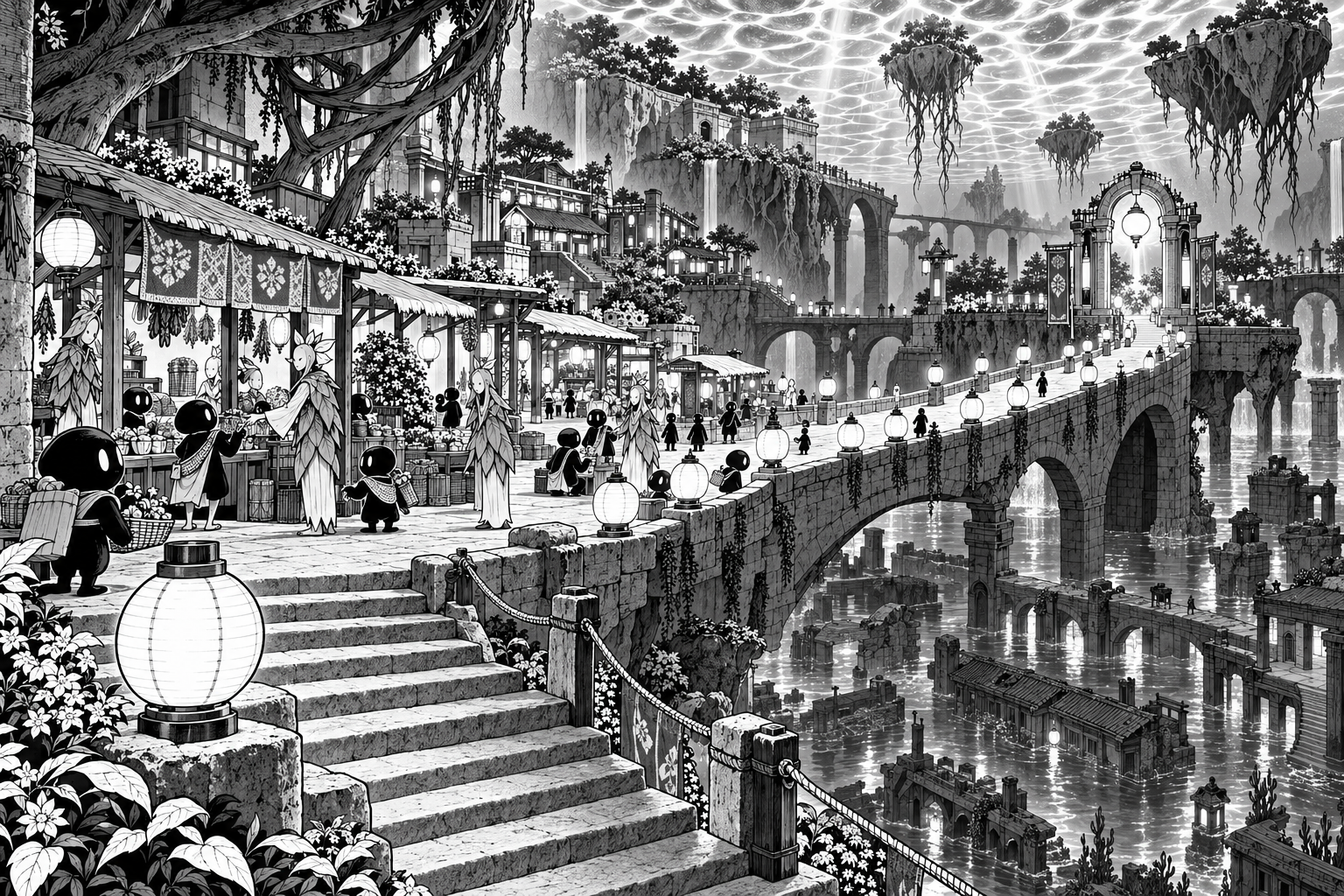
Lower lantern blooms close around sleepers and slowly reopen at morning, making a whole street breathe with light.
A few unexplained incidents are recent enough that people argue over whether they signal war, bad maintenance or a dishonest official.
Couriers argue over race times, children copy harmless shell tricks and families plan a lantern festival. War stories are serious but distant enough that some young people find watch drills tedious.
Lantern Exchange has food, festivals, jobs, family arguments and local pride. Its economy depends on neighbouring lower settlements and salvage, not an openly acknowledged surface trade route.
Roof moth silk warms winter clothes; sun-storing stone keeps bread warm; tuned shells carry brief courtyard calls. Each craft needs somebody to maintain, harvest or teach it.
Above and below sing different verses of a return song. Neither public knows the other's verse; the similarity becomes a discovery after the entrance.
Memorial food and repaired tools matter even when no ghost is present. Most people cannot verify a spirit user's account. Hearing a ghost does not make Sumbi responsible for every family's grief.
If missing taste is chosen, meals can still offer him company, texture and presentation. Adaptation, kindness and an exploitative cure promise create different interactions.
Stone Orchard above Spring Terraces
A harvest contest becomes a Bloomback territorial fight. Choose a detour, protect workers or secure the pollen lure first.
Six-legged movement, closing petals, climbing stone and a grab opening.
An invasive clamp can be distinguished from the animal's natural warning; not every hostile creature is evil or Ink.
Bell Steps tower galleries
Nari needs a certification route; Ryeon's test frame locks a higher stair during a dangerous demonstration.
Vertical reach, exposed anchors, sound counterplay and choosing whom to rescue.
A useful public ward can be redesigned into a weapon; device craft is not morally neutral in every use.
Lantern Exchange night market
A ghost has borrowed a performer's mask to finish one last act, but the living performer has another commitment.
Track movement, negotiate, catch a falling prop and protect the performer's choice.
A dead person's sincere wish can still impose unfairly on somebody alive.
Tide Archive's roof-moth loft
A warming-stone failure draws hungry Cinderlings toward fragile stored paper while a keeper refuses to let the collection be destroyed.
Shelter documents, use air movement, bait a cone and strike its exposed ember.
The natural creature follows food. A missing maintenance tool may explain the accident without another conspiracy.
Individual people with different memories, wants and capacities, not one faction and not Ink.
Some want help leaving, some want to stay and some misunderstand what happened.
A helpful ghost can still demand too much. Sumbi must choose boundaries and cannot promise someone else's forgiveness.
Colossal shelled or stone-backed fauna whose routes predate current towns.
Food, breeding and seasonal shelter, not an ideology.
A sleeping shape can make a hillside; waking it changes roads. People must adapt without assuming the Choir caused every danger.
Surface performers, teachers and merchants competing for apprentices and contracts. They do not all know the hidden world.
Prestige, income, inventions and travel.
They offer Nari a life beyond home and Meok a tempting remedy claim. An honest teacher and a fraud can share a market.
Distant surface cities and unexplored lower routes remain deliberately incomplete.
Do not assign a continent-wide evil hierarchy yet.
A letter, imported tool or traveller can open the next arc when a personal goal leads there, rather than a lore lecture naming every kingdom.
map
This is the author’s relationship map. Ordinary surface people do not possess it or know an inhabited realm lies beyond the concealed threshold. Positions and distances remain provisional.
On a small screen, scroll the map sideways, or open it at full size.
On a small screen, scroll the map sideways, or open it at full size.
The existing home town, expanded with basalt lanes, courtyards, sea walls and a working shore; this is a planning label, not a rename.
A stone causeway, wind-cut arches and a bell tower overlooking a surface road. The destination is visible before the danger.
Surface villages around stepped basins, stone orchards and a distant intake tower. Bell Steps connects them to home.
A secret lower town with dry stone terraces, reclaimed market halls, root gardens and a white-lamp skyline. The proposed friendly guide lives here.
A lost route-house with an upper sealed room and a hidden lower entrance, a balancing shaft, side galleries and a visible exit balcony. Original function can still be revised.
A coastal storehouse on a local low-tide road, with ordinary upper records and a restricted buried chamber. Its staff do not all know the secret.
people
Friends can leave. Protectors can be wrong. Villains make deliberate choices.
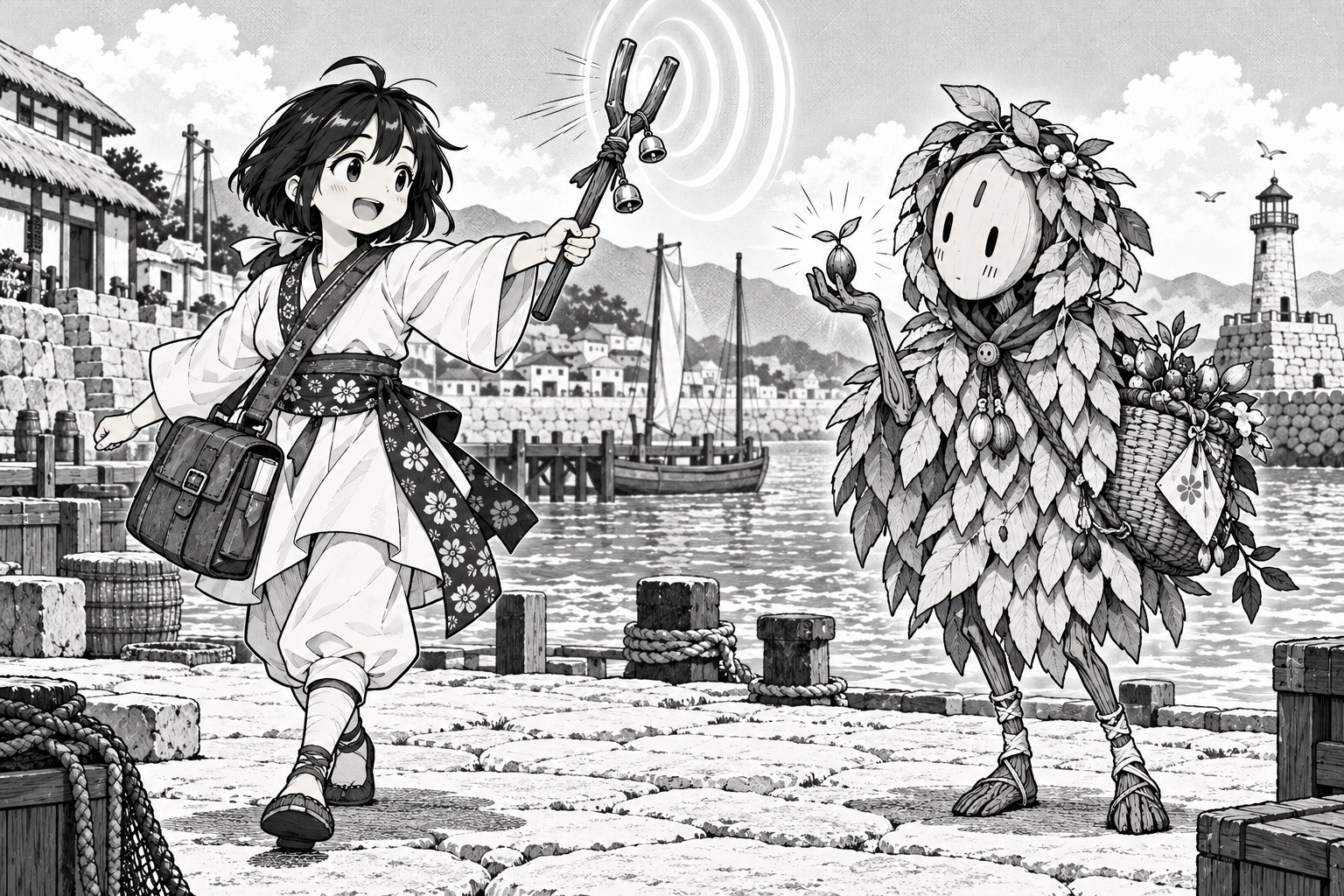
Human apprentice bell-runner, about fifteen; a surface friend introduced after Chapter 1.
Proposed friendly non-Ink leaf-cloaked guide in the hidden world; exact species remains open.
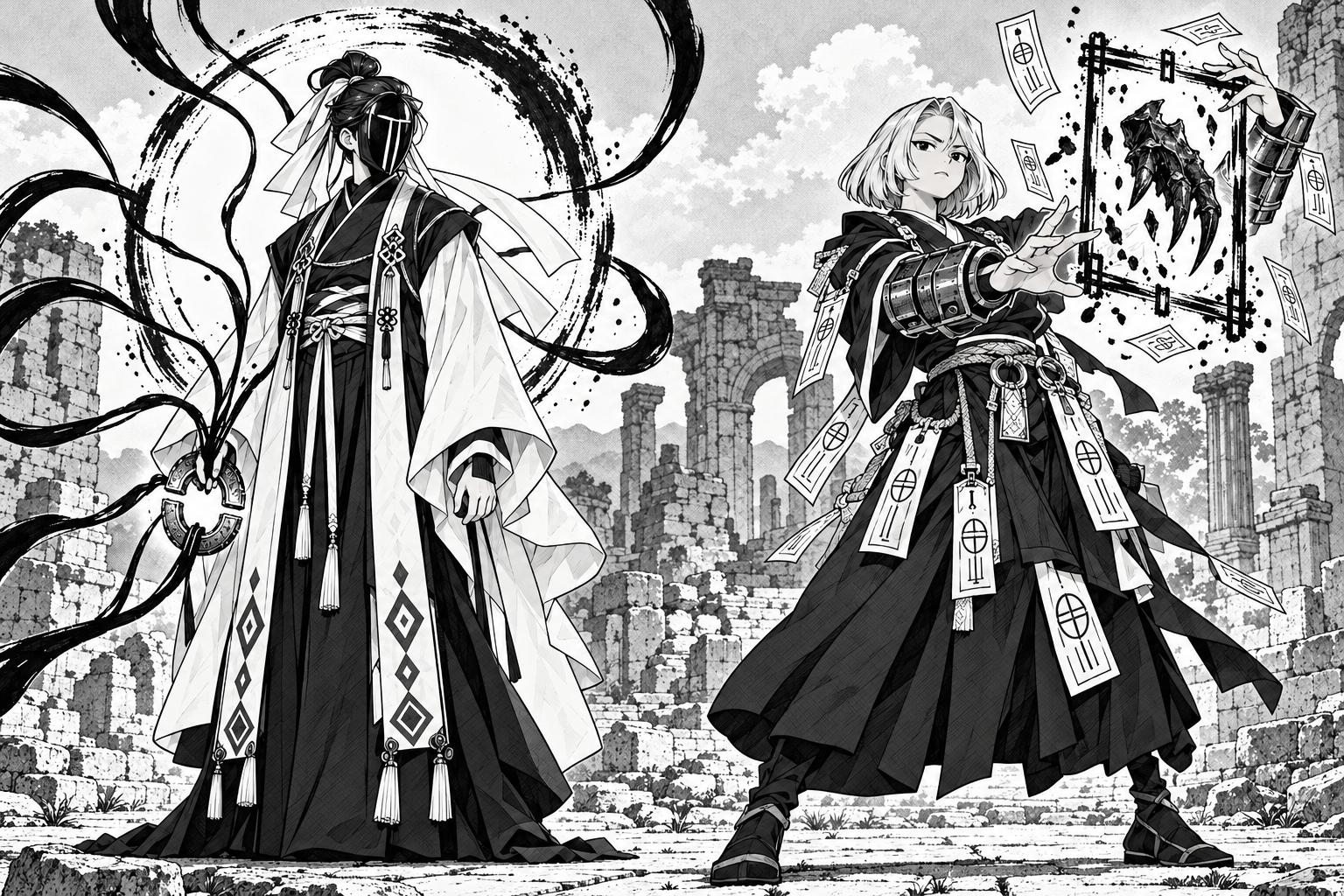
Recurring mastermind of the proposed Unfinished Choir. Identity, species and any relationship to Chapter 1's stamp-holder remain unresolved.
Use the stolen return call for small breaches, provoke fearful containment, then create a crisis in which both sides seem to need his control. A lower rescue movement and a surface security response become tools.
Enjoys a perfectly coordinated performance and hates a voice entering at the wrong time; an improvised act of friendship can threaten both his spell and worldview.
An informed lieutenant who chooses the plan and wants command, not an innocent person under the same control.
Steal a Bellward test device, stage a detention that turns ugly and deploy the improved design against Meok after studying his reach.
Formal, sporting when winning and inventive about interpreting her own rules. She can enjoy a duel while remaining responsible for real cruelty.
enemies
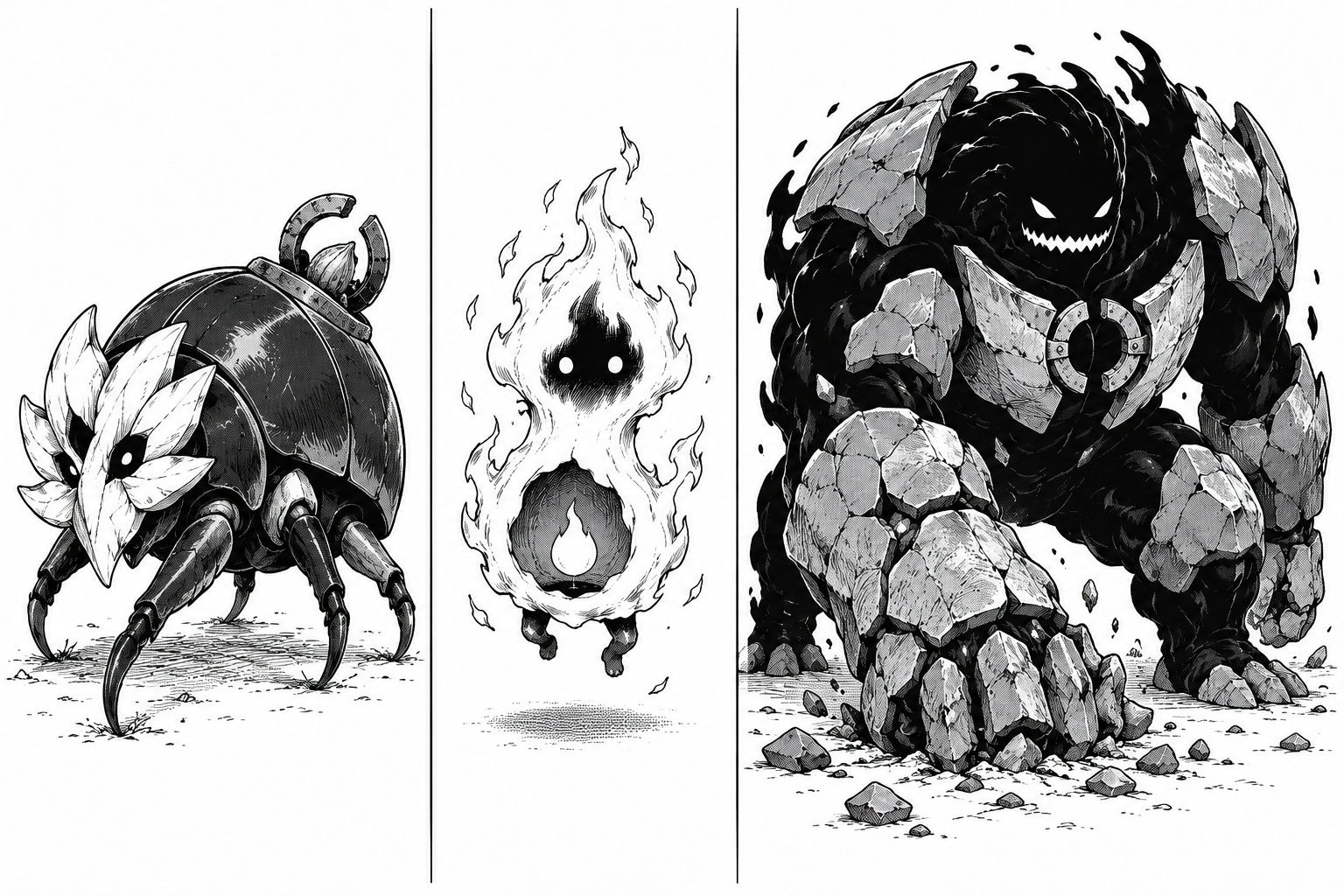
A naturally occurring flower beetle; some individuals become corrupted.
A heat-feeding elemental creature, not Ink or a dead person's ghost.
A proposed large Ink creature used as a controlled boss; its uncorrupted nature and personhood need a decision.
Sumbi reveals an opening that exists. Meok chooses the timing and executes the move. Neither ability automatically cures corruption.
history
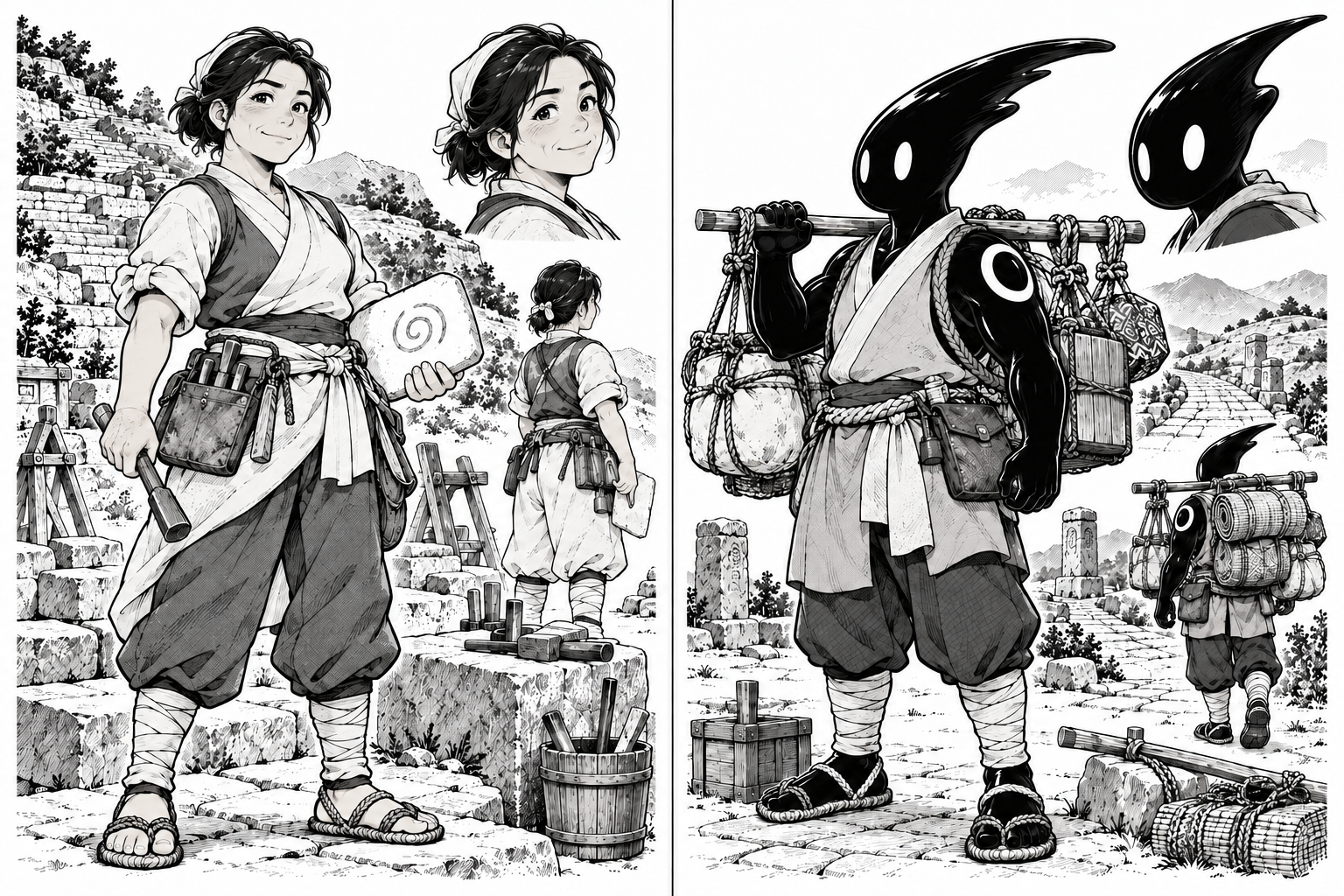
Human route-maker remembered for turning an isolated crossing into a shared civic undertaking.
Historic Ink courier who brought a stranded mixed convoy home after a crossing failed. 'Returned' does not mean resurrected or formerly human.
About 180–120 years before the present; approximate workshop dates
Communities around the coast and hidden terraces build shared routes; Euna and Biro become associated with their expansion.
Mixed crews, crossing festivals and household visits leave ordinary traces. It was useful coexistence, not a flawless golden age.
Only fragments survive above. Lower stories preserve more names but disagree about responsibility.
About 100 years before the present
A cascading route disaster and fear of what crossed lead keepers to seal passages. The exact first disaster remains unresolved.
Interrupted travel becomes permanent separation. Surface records lose context over generations; lower communities adapt to internal routes and salvage.
During the route disaster, the working route archives were lost or sealed with the stations. Ordinary family stories survived as tales of impossible visitors, without a usable destination or means to verify them. Generations of inaccessible roads, reused buildings and the later war's devil imagery turned those stories into folklore. A few bounded insiders now possess fragments, not a public map.
About 13 years before the present, subject to approved Chapter 1 chronology
Use the approved chapter's actual wartime events. This workshop does not add a victor, rewrite Hu or Bu, or identify its shadowed figures.
Attacks make the devil interpretation credible. Surviving families preserve warnings, equipment and watch duties.
Living surface people remember danger from creatures, not a tour of a concealed society.
The following years until this season
Intact seals and staffed watches prevent large incursions. Lower communities avoid another ruinous conflict and keep their own fragile roads working.
Children grow up with festivals, local rivalries and ambitions. Public life returns without all grief disappearing.
Some adults remain wary; younger people experience watch drills as inconvenient routine. Peace was maintained by work, not one hero staying alive forever.
This season
A storm exposes a buried relay chamber. Seo's agents steal a tuning tablet that can counterfeit old route calls; the public reports only storm damage and a missing relic.
Small breaches and command marks can cross protections that previously held. Ordinary neglect becomes easier to exploit.
This is the specific why-now event. Natural storms still exist independently of the Choir.
The original disaster remains a mystery. Why danger returns now is concrete: a recently exposed relay supplied stolen route knowledge. The Chapter 1 war is preserved rather than retroactively explained by this proposal.
factions
The same rescue can look like an invasion. The same welcome can offer real help and a coercive obligation.
growth
Roles describe practised work and combat habits, not rigid birth classes. A craft can be broadly learnable while a rare gift opens a particular perception. Access, time, teachers and good judgement matter alongside power.
Courier routes, retrieval, positioning and rescue.
Precision and recovery before greater distance. Nari can teach movement timing even without an Ink body.
Preparing boundaries, controlling a breach and protecting a group.
Reliable placement and safe releases before larger fields. Chapter 1's real brush stroke remains a distinct established reference, not a universal trick everybody knows.
Scouting, reading openings, stabilising injuries and timed support.
Sumbi earns one reliable use at a time and learns when not to commit. A spirit is a partner, not interchangeable fuel.
Tools, shelter, local devices and a space's safe operation.
Useful craft expertise can change an adventure without becoming a combat superpower.
Learnable options with teachers and counters. Meok does not unlock all of them merely because this page lists them.
One smooth tapered extension with a taut line from shoulder to hand.
A broad weighted hand and crescent motion, with a compact stance.
Compressed folds and a narrow silhouette that visibly reforms.
A continuous attached loop returning toward its own anchor, with no detached body pieces.
Many households encounter it, although not everyone can make it. Shell calls, warming stones and lamp maintenance have limits and labour.
Shows inhabitable magic and gives ordinary people useful expertise.
Reliable field healers, licensed ward workers, expert couriers and skilled Ink forms need time and access.
Visible teachers, rivals and attainable milestones make advancement plausible.
Spirit-user compatibility is rare; the owner's one-in-a-million thought remains provisional rather than a census fact.
Sumbi receives interest and pressure, but gift does not substitute for skill or imply inherited fate.
Permanent restoration, full transformation and changing the old destiny system are claims with incomplete evidence.
They motivate quests and deception. A claim becomes a dependable power only after an earned demonstration.
Use three rungs: a safe first success, a demanding use with a cost, then an inventive combination of established actions. Gain a tool, contact, permission or better judgement as often as a bigger spell.
Fees, time away from work, permits, scarce safe practice grounds and faction control affect who can train. Lower craft yards offer alternative teachers the public above does not know exist. A generous scholarship can be sincere even when an inner circle wants influence. Do not declare Sumbi poor or give Meok all four styles immediately.
Meok begins with his established reach and heavy hand; the other forms are learnable options to choose, not compulsory unlocks. Sumbi's first sight comes before reliable reveal, mending and a timed blessing; exact order and end-state remain proposals.
His reach, enlarged hand and body control make fights, rescues and terrain interactions distinctive. As an Ink person with a chosen surface home, he can ask both sides for a future they have not imagined; that is an opportunity, not a guarantee that every Ink trusts him. His desire for humanity can conflict with asking others to value Ink lives.
Her gift gives access to a relationship and perception others lack, while training makes her support reliable. She can hear a burden people call sacred and ask whether the person bearing it agrees. Her own attachment to a ghost can compromise that conviction.
Meok creates and executes an opening; Sumbi reveals, protects or buys time. They can love each other while disagreeing about secrets, risk and who must wait to be saved.
Ordinary couriers, healers, cultivators and guards do indispensable work. The pair opens possibilities; towns must choose and maintain any workable change.
adventure
Three connected, disposable coast tests after Chapter 1. They are separate from the lower-world playable sketch below. The entrance is assumed to have been visited; its final trigger and wider return rule remain open. Nari’s knowledge of Meok must be earned in an on-page post-reveal meeting.
Nari: 'No moving the finish bell.'
Meok: 'You added that rule because it worked.'
Sumbi: 'Win first. Argue on the way back.'
Sumbi: 'After it spits. The back opens.'
Meok: 'I see it.'
Sumbi: 'It's a fare receipt.'
Meok: 'They paid to come here?'
Sumbi: 'Someone wrote, See you next summer.'
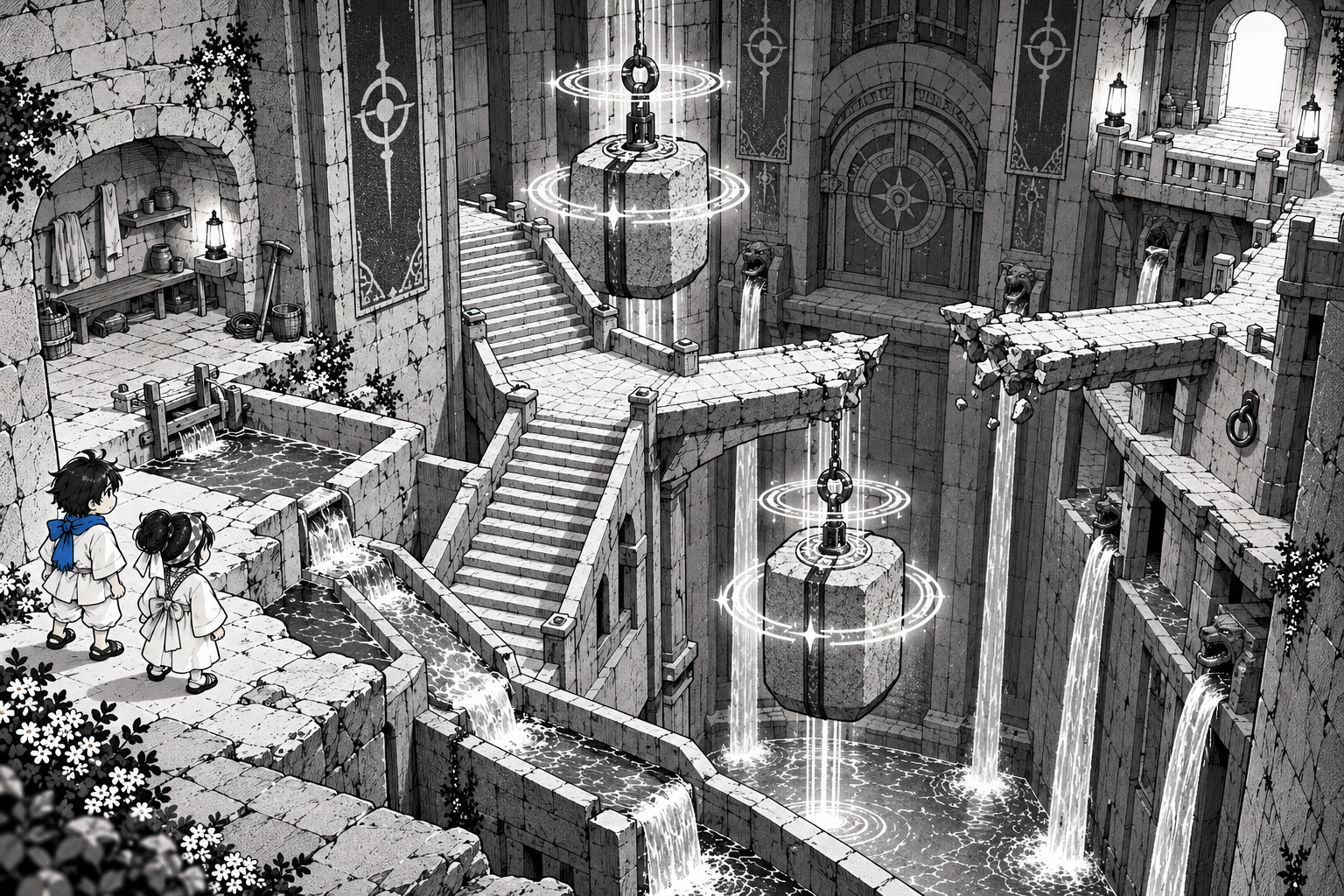
A provisional sketch of what the player wants, what actions work, and what changes afterwards. It is a bounded test rather than a selected chapter or final game design.
Open the Counterweight House return balcony and bring all three stranded repair-crew members to the entrance refuge. The white-lamp balcony is visible at the start; a local requester names the crew and route problem. A command record supplies a later investigation lead, not an additional rescue prerequisite.
R1 is the threshold-side refuge at Lantern Exchange, beside the already-crossed accepted entrance. A short dry approach leads to Counterweight House at R2. R2-R6 are the route-house slice. The visible R6 balcony is an authored sightline along that approach, not another portal. The R6-to-R1 walkway is a local lower-world connection.
One aimed attached reach can grasp an authored handle or an enemy's currently exposed joint. A separate committed weighted strike exploits a stagger. Movement and dodge position the player; retraction recovers the reach. No arbitrary scenery manipulation or implicit player-pull is supported.
One requestable, cancellable local fairy viewpoint at R3. The camera and player attention move away from Meok while Sumbi concentrates; neither support nor player-controlled combat continues concurrently. Physical interruption cancels the link.
At R3, the fairy flies beyond the blocked landing to inspect the mechanism, then returns toward Sumbi as if inviting her attention. For a brief unexpected glimpse, she sees the handle from its angle; the view breaks when she looks back at Meok. He asks what she saw. Sumbi chooses to try again and asks the fairy, 'Can you show me?' It willingly leads her attention back to the same local vantage. Show departure, her concentration, the changed view and a deliberate return. The player then learns the request/cancel interaction. This is one first shared-sight discovery, not prior mastery, a teacher's instant diagnosis or a universal fairy rule.
Only Sumbi shares the fairy's vision in the fiction; the player temporarily experiences her viewpoint. After returning she tells Meok what she noticed. Meok does not automatically inherit her sight or knowledge.
The same entrance threshold is visibly usable from R1 throughout this test. Returning through it safely ends or pauses the visit. Re-entering restores the latest saved local state. This is a selected rule for this one test, not every portal's universal rule.
The repairer previews the benefits and warns that interrupting the relay will arc through a record plate still installed in its terminal. A removed plate is unharmed; both approaches rescue everyone.
After success both physical approaches reopen, but the missed reward is not silently granted. Escort-first can later help an archivist or maker reconstruct the damaged record. Relay-first can return a repair tool and assist a short safe repair task to earn the lesson. These are explicit later tasks, not part of the initial completion trigger.
The lesson practises a cleaner retraction/release of Meok's existing reach and creates teacher access. It does not unlock four styles, change his species or prove the humanity remedy. A real added capability requires a separately chosen contract.
These are semantic action names; final keyboard or controller bindings are not selected here. The prototype must expose all actions and their current availability consistently.
Only one arm is extended at a time in this test. Every extension visibly connects to the same Meok body. Grasp and weighted strike use that arm sequentially. This scope limit does not rewrite his capabilities in Chapter 1.
Aim identifies an in-range authored target. Press reach to extend. A valid exposed joint or handle attaches; solid shell produces a visible failed contact. Out-of-range aiming has a distinct unavailable cue. All other scenery is collision, not a secretly usable grapple point.
The valid R3 handle pulls its mechanism, not Meok. It automatically releases once its latch engages. There are no swinging or player-pull anchors in this slice.
Connecting to an exposed joint staggers the enemy and automatically releases the grasp. Meok retracts before the weighted strike becomes available. The stagger lasts long enough to complete this deliberately taught sequence at the baseline tuning.
Release or cancel an ordinary grasp to retract. A miss, shell contact or completed mechanism pull also retracts. No second reach or weighted strike begins until the arm has returned. Ordinary movement remains available during an unpinned extension; dodge cancels and retracts it instead of preserving a free tether.
From a planted stance, commit the enlarged hand toward an in-range target using the same attached arm. Wind-up, contact and recovery are visible. The strike staggers or damages the selected objective only in its required opening; hard shell gives clear ineffective impact feedback. It does not infer a universal living-Ink kill rule.
The boss pins a premature extended reach during its signalled forearm sweep. Normal reach, strike and dodge are temporarily unavailable; the retract action changes to a visible brace/release cue.
Hold retract to brace. When the enemy forearm visibly lifts, release retract during that indicated window. Success frees and retracts the arm, restoring movement immediately.
Failure causes one damage event, followed by automatic arm release and normal control. The boss cannot retain the arm indefinitely or chain a second pin before the player has regained control.
The first pin presents the release cue with enough time to read it. Tune the window and damage after testing. If this interaction is frustrating, simplify the prototype rather than justifying it with new lore.
Reach distance, strike reach, wind-up, recovery, stagger duration, dodge distance and damage are provisional balance values. Tune them against the contract; do not alter valid target types or victory meaning accidentally while tuning.
At R3, the fairy flies beyond the blocked landing to inspect the mechanism, then returns toward Sumbi as if inviting her attention. For a brief unexpected glimpse, she sees the handle from its angle; the view breaks when she looks back at Meok. He asks what she saw. Sumbi chooses to try again and asks the fairy, 'Can you show me?' It willingly leads her attention back to the same local vantage. Show departure, her concentration, the changed view and a deliberate return. The player then learns the request/cancel interaction. This is one first shared-sight discovery, not prior mastery, a teacher's instant diagnosis or a universal fairy rule.
When both characters stand at the marked safe observation landing, request support. Sumbi agrees to this local use, closes her eyes and remains at the landing. The player transitions to a fixed fairy vantage overlooking the shaft and can pan the view. No unrestricted free-flight system is required.
The viewpoint shows how the handle connects to the platform and identifies a reachable latch target. It does not automatically operate the mechanism, supply a full map or reveal every enemy's truth. An observant player may still solve the mechanism from Meok's normal view.
While viewing, the player cannot move, dodge, strike or reach as Meok. His body remains in its actual location; it gains no invulnerability. Sumbi cannot watch her immediate surroundings while concentrating. This first safe use teaches the tradeoff without requiring a resource meter or combat support AI.
Cancel immediately returns the camera and input to Meok at his unchanged position. The fairy returns through the established visual cue. No teleport or location reset occurs.
Damage to either child or an externally broken link cancels the view automatically and restores Meok control. In this slice R3 is initially safe; the interruption rule prevents the feature being interpreted as invulnerability. No unseen timer drains a new magic resource.
Only R3's local vantage is supported. No heal, buff, magic weakness mark, enemy control, mind reading or spirit tax is implemented. Later use must receive a separately approved interaction contract.
Only Sumbi shares the fairy's vision in the fiction; the player temporarily experiences her viewpoint. After returning she tells Meok what she noticed. Meok does not automatically inherit her sight or knowledge.
Warning petals -> pollen volley -> exposed rear joint -> warning again. Valid grasp during exposure creates stagger and retracts the arm; weighted strike during stagger drives it off. Shell contact does not create a hidden opening. Retreat resets an unfinished encounter; drive-off persists at R2 exit checkpoint.
Visible shoulder lift -> ground slam -> signalled forearm sweep -> chest-clasp recovery -> repeat. Valid grasp during clasp recovery creates stagger; retraction completes before the weighted strike window ends. Early reach during sweep enters pin. Two successful baseline cycles interrupt the relay, then authored separation opens the rescue route.
The imposed rhythm stops briefly, enabling physical separation and route release. Neither a pause nor a withdrawn enemy proves the corrupted individual restored. The relay's control remains a local demonstrated mechanism; universal corruption history is open.
Not an implemented objective or outcome in this slice. No reward or story flag assumes the player killed an Ink person.
Allowed before encounter completion. Preserve committed story approach, reset unfinished encounter progress and restore it from the selected attempt start when re-entering.
Combat incapacitation or a fall returns to the latest checkpoint snapshot. Restored characters and local state are a gameplay retry convention, not canon resurrection. Never save a surprise civilian death or an indefinite pinned state.
Restore committed choice, crew and evidence flags first; restore route and alcove state from that checkpoint; reset active enemy cycle and Meok's arm to fully retracted; put both leads on the safe landing; return input to Meok. No shared-sight camera survives a reset.
beliefs
Saving somebody does not give you unlimited claim over somebody else.
Concrete later scene test, not an approved chapter. Assumes the pair has already discovered the lower town, Nari has subsequently learned of it and chosen to come through an on-page encounter, and spirit perception, the ward and relevant Meok abilities have been introduced.
Ima, a bound dead night-watch keeper, wants to leave. A corrupted Ink porter, Gon, struggles below the ward and briefly stops attacking to shield a fallen child.
Meok interrupts the porter's command long enough to see one deliberate protective act; restoration looks possible but remains incomplete. The command returns and Nari is hurt while helping the child. Ima's ward continues holding the attacker and is visibly draining her; Sumbi hears her ask for release.
Meok asks for more time because he saw Gon choose. Sumbi refuses to treat Ima's repeated captivity as an unlimited resource. Moru points out that living residents will have to take the shift.
Meok: 'He stopped. He knew that child.'
Sumbi: 'And she asked to leave.'
Moru: 'Then someone living takes the watch.'
secrets
Public belief, a deliberate lie, an author’s proposed truth and an unanswered question are different things.
Surface public
Magic, ghosts as belief or occasional testimony, coastal hazards, the recent war and hostile Ink creatures.
An inhabited lower world, current lower communities or ancient shared travel. Hell is a fearful interpretation, not an accurate public map.
Bells warn of hostile breaches; people have never seen an ordinary lower market.
Ordinary Bellward crews and civic officials
Dangerous anomalies, sealing protocols, damaged springs and local coastal roads.
That their water decisions flood homes below. Most officers are not participants in a hidden international policy.
Maintenance maps label sealed ends as dead channels, not settlements.
Bounded surface insiders
Archivist Iri holds fragments proving an inhabited other side. Hearthward Prior Hae knows a restricted disturbed relay reacts to a compatible gift and that brief willing contact can steady it; Hae interprets this as a keeper's permanent duty. Seo and Ryeon possess enough stolen knowledge to exploit old calls.
These are separate interests, not an all-knowing government. Iri lacks current lower geography; Hae does not know whether the inherited ritual is the only solution.
Only sealed records and direct restricted visits support this knowledge. Add another informed insider explicitly rather than silently expanding the conspiracy.
Lower residents
Their own inhabited region, old routes, surface water arriving and inherited stories of a bright coast.
Most residents lack reliable knowledge of current surface towns and intentions. Some doubt humans still live there; others blame the upper world without knowing who controls its outflows. A few intermediaries have direct evidence of inhabited upper pockets, but this does not give them a safe destination or route capacity for a district's evacuation.
Ancient salvage and disputed stories circulate widely. Direct visits and concealed exchange belong to a small, explicitly identified network; its reports are incomplete and not publicly verifiable. There is no ordinary open interworld economy.
Sumbi and Meok at the entrance
Their personal Chapter 1 history and what they actually encounter together.
The inhabited world's extent, the cause of its troubles, the cult's expectations or a complete history. Meok's origin does not automatically give him a map or knowledge of every Ink society.
They discover people beyond the beautiful threshold; later clues must earn later conclusions.
Author and workshop
Only owner-approved facts are fixed. Proposed hidden truths below describe one version to test.
Gift origin, divine intention, exact ancestry, a final cure, the ending and whether either destiny option will be chosen.
Keep author truth distinct from public belief, a deliberate lie and an unresolved decision.
Yes in this workshop: the entrance leads to people with ordinary lives, not an empty monster realm.
The public above speaks of devils, haunted pools or Hell without a reliable map.
A bounded keeper can knowingly deny a restricted record; ordinary people repeating folklore are mistaken, not necessarily liars.
How extensive the hidden world is and how much either side once knew.
Discovery changes the party's model of danger and belonging. It remains secret to the public until a later chosen event.
Ancient roads supported shared work and travel, with real inequalities and quarrels. The closure predates living surface memory.
Upper folk remember a coast defended from devils; lower stories describe a lost bright shore.
The Circle's restricted account removes evidence of shared duties and contested consent.
The original disaster and the whole chain of closure decisions.
A route becomes a connection worth considering, not proof that the past was perfectly harmonious.
Old misrouting is worsened by recent sabotage. Surface officials do not know there are receiving communities.
Above, rivals hoard water; below, people assume the unseen upper world knowingly attacks.
An altered repair report hides tampering and an embarrassing loss.
How much is ordinary decay, ignorance and deliberate intervention.
The next objective is practical, and both sides must revise blame when consequences become visible.
Stolen relay commands open small hidden routes and force corrupted bodies through them.
Ink materialises anywhere because it is evil by nature.
The Choir stages incursions as proof that no independent peace can hold.
What corruption damages, how far it can be reversed and whether every attacker is controlled.
The early fight gains a cause; a later rescue opportunity tests Meok's belief without erasing earlier harm.
In this local proposal, a damaged relay recognises a compatible gift and can be steadied by brief willing contact. That observed response does not establish divine intention, exclusive compatibility or permanent service as a unique moral duty.
The gifted are born to complete burdens ordinary people cannot bear.
Hae's inner circle claims all earlier keepers freely chose permanent service.
Gift origin, who built the binding and whether another design works today.
Refusing Hae's interpretation leaves an existing local fault rather than creating a curse. A slower evacuation and attended closure is workable but costs access, time and labour; any wider destiny model still needs a deliberate choice.
Not selected. Professional knowledge of dangerous diving is enough to explain the restriction.
Sumbi hears excessive fear; her mother considers it experience.
None required.
Whether a particular rescue shaped the warning. Do not make hidden-world knowledge the default.
Independence can grow through skill and negotiation; her mother need not be foolish or secretly controlling destiny.
Unresolved. Distinguish bodily deprivation, social acceptance and an actual transformation.
A tale says the old crossing once gave a visitor a missing experience.
A merchant can sell an unproven remedy as certain.
Whether the tale concerns taste, temporary perception or something else, and what it costs.
A personal temptation can cost him something without making his desire morally wrong.
Surface shells, lamps and arches are familiar local magic. A particular concealed combination reveals a road into the other world; nothing on the public road advertises an inhabited realm.
The reflection shows a route the dry stone does not; beyond the threshold, lamps reveal a consistent destination.
Finding an entrance does not supply its history or make every reflective pool a portal.
Exact trigger, safe return conditions and the shell's optional role remain to be agreed.
In this local proposal, rain and springs replenish upper catchments. Intact old channels carry their excess past occupied lower terraces into runoff routes. Decay and recent sabotage now divert part of that finite supply into streets faster than local drains can remove it, so upper stored levels fall while lower homes flood. Ordinary surface crews see basins and supposedly dead channels, not an inhabited receiving side. Restoring one bypass can save a street but changes where its water goes next; the downstream receiving place must be checked.
A marked basin falls while another rises. The same carved measuring scale appears above and below.
A valve puzzle cannot resolve a whole region by ignoring the receiving community.
The wider water cycle, the final outfall and the role of natural tide versus magical routing remain open. Before a water puzzle is drawn, identify its local source, ordinary bypass, present diversion and receiving space; do not depict an endless source or a flood vanishing without an outlet.
Floods destroy homes and escape routes. Separately, forceful water can threaten an Ink body's cohesion; protection, exposure and recovery need testing before this becomes a combat rule.
Dry refuges are crowded; an enemy braces against a jet while smaller droplets do not erase it instantly.
Do not make all contact with water fatal or treat every Ink body alike without checking Chapter 1 and gameplay.
Whether pressure, immersion, particular water or corrupted condition determines the bodily effect.
Important devices show preparation, target, effect and aftermath through moving marks, light, sound and physical change.
A ward draws a visible circle, catches an Ink limb and leaves that limb unable to stretch until the field breaks.
A neutralizing device needs range, warning and counterplay. It cannot silently solve every Ink encounter.
Its exact relationship to the existing brush stroke and who knows how to build or defeat it.
A hostile agent can impose a command through an invasive mark. The altered body and repeated command distinguish corruption from species, temperament and ordinary predation.
A recognizable ordinary creature struggles against a mismatched moving seal before attacking.
A revealed weakness creates an opening, not guaranteed purification. Some enemies can also choose evil without being corrupted.
Reversibility, consent, what the process damages and whether Meok's hopeful belief is always achievable.
For this local test, the seals that maintained the quiet are dormant closures serviced by ordinary crews; they do not require a gifted person sitting at them. A counterfeit call has disturbed one relay, causing brief uncontrolled openings. Nobody is currently serving as its permanent keeper. The control visibly reacts when a compatible person approaches, but this is recognition, not consent or automatic binding. During an informed trial, willing contact steadies the relay for a short interval. Removing contact ends that damping: the already disturbed relay resumes its pulses, while sound seals elsewhere stay closed. Crews can instead isolate the damaged relay and rebuild an attended local closure after evacuating the exposed route. That costs labour, time and access, and people beyond the closure must be rescued first or risk being stranded. Hae calls permanent personal service the only acceptable solution; the observed reaction proves only a temporary stabilising effect.
Show a quiet closed route, a forged call, a brief opening, the control's recognition signal, a consensual short damping test, and its return to the same fault when contact ends. Show crews assembling the slower closure while people move clear.
This establishes one damaged relay's behaviour. It does not prove that Sumbi is the only compatible person, that spirit sight causes compatibility, that permanence is required, that refusal is a curse, or that a shell or bloodline grants the gift.
The full network, the origin of compatibility, historical keeper experiences and the choice between living-anchor and compulsory-return destiny models remain unresolved.
Track four things separately: a real magical reaction, what a faction claims it means, what the person believes, and what happens if they refuse. Prophecy can be mistaken without making demonstrated danger imaginary.
Sumbi is compatible with a living-anchor role that sustains a crossing. Meok is designated as material for its repair, risking his continuing individuality. A faction calls both duties fate; the story has not yet proved that interpretation or fixed the ending.
The old system compulsorily returns displaced beings to their assigned side. Sumbi's gift can hold a crossing against this recall; Meok is being recalled below. Preserving their chosen life requires changing who controls return, not absorbing Meok. This offers active travel and recurring escapes before any final sacrifice pressure.
Try the compulsory-return alternative if living anchors make the adventure solemn too early. Keep the harder anchor proposal for comparison rather than stacking both into canon.
Another solution should require discovering a lost route, recruiting disagreeing communities or sharing an ongoing maintenance cost. It cannot be a last-minute new spell that makes earlier suffering unnecessary.
No bloodline gift, maternal sacrifice, shell-as-chosen-key, guaranteed death or universal restoration is settled. An inherited object may help someone operate a system without causing their gift.
Chapter 1's people, visual language and deliberately staged Ink reveal; the wonder of the Chapter 2 entrance.
The inhabited lower world is a secret to ordinary surface people. Magic itself is overt and familiar. An inherited shell does not mean an inherited gift. Sumbi's mother warned her not to dive; that does not establish a conspiracy.
The existing lower guide, leaf people, flooded gardens, valves and factions are possible designs, not facts validated by previously generated pages.
Use Chapter 1's crisp black-and-white printed manga. Distinguish people and enemies by silhouette, facial marks, equipment, value and hatching. Only established selective accents, such as Meok's blue scarf, carry over automatically. No new colour system is approved.
Develop the text descriptions first. Obtain writer sign-off before starting any new art generation.
A game developer checks playable objectives and mechanics; an independent agent checks world logic and rationale. Resolve material issues and request re-review.
After the text passes, generate only the necessary concept assets in The Last Ink style. Inspect existing draft assets before spending on replacements.
Review passes do not establish canon. New lore, mechanics, cast and images remain provisional until the owner chooses them.
research
Writing and game-design lessons, with concrete applications to this proposal. These are design tools rather than formulas.
Provisional matches to the owner's references, pending title confirmation: Veil of Shadows, likely 月鳞绮纪, and Fate Chooses You, 佳偶天成. The programmes exist; their identification as the intended inspirations is not yet confirmed.
Official distributor synopses and listed episode or clip descriptions only. No claim to have watched the episodes or assessed the complete series. Last Ink applications are new proposals, not sourced facts or new canon.
Independently motivated hunters converge around one contested supernatural power.
Apple TV official programme listing
A staged transformation quest draws the pair through competing institutions.
iQIYI official programme listing
Read the fuller observations, interpretations and limits →
For a Last Ink episode, name the personal wish that starts movement, the two groups that want incompatible outcomes, the older magical rule causing trouble now, and the ordinary pleasure worth preserving. Show a choice and its consequence before adding another historical explanation.
Their account of converting Magnolia into 3D exposes the cost of inconsistent manga geography. They also discuss party bonds and different game and manga rhythms.
The developers connect new movement and explorable spaces with changed perception of familiar landscapes; they describe dungeons with regional identities.
Players infer events from related environmental evidence; the environment can also telegraph danger and help navigation.
Develop the connections and social consequences of existing magic before continually adding systems.
Distinguish what magic cannot do, what opponents can exploit, and what using it costs.
Important mystery conclusions need multiple clues so one missed or misunderstood detail does not block progress.
writer
Text is reviewed before further art: writer, game developer and independent world-logic gates. Passing these reviews means the proposal is usable for development; only the owner chooses canon.
PASS
I would write adventures in this version. It is sufficiently connected, inhabited and pressured to develop a game/manga story and prepare focused visual briefs. This passes the world-concept text gate, not final canon approval, a complete chapter script, finished level design or the later atlas/art/map gate.
2026-10-11
Design/World/World_Workshop_20261011_v2.json
PASS
No blocking text contradiction found. Three local clarifications are recommended; they do not require another world expansion.
Text only. No generated world image was inspected or used to reach this verdict. The foundation is Chapter 1 and the liked Chapter 2 entrance. Later chapter explorations supply no approved evidence. All new world material remains a proposal.
I would write adventures in this version. It is sufficiently connected, inhabited and pressured to develop a game/manga story and prepare focused visual briefs. This passes the world-concept text gate, not final canon approval, a complete chapter script, finished level design or the later atlas/art/map gate.
Resolved sufficiently for concept development. The exact original disaster remains an appropriate mystery; see the secrecy clarification below.
Resolved. Friends, antagonist, lieutenant and historical figures have wants, traces and distinct silhouettes to brief.
Resolved. Independent wonders now create play and daily work, not only solutions to the main crisis.
Resolved at proposal level. The case gives each conviction visible evidence, a competing need and a cost. It need not decide the series' moral answer.
Resolved. The staged breaches, wrong alarm and controlled-war plan give a meaningful direction if nobody intervenes.
Deferred to the later visual gate, not passed by this text review. The owner requested text before drawing.
medium, nonblocking
history: The Long Closing / knowledge_matrix: Surface public
About a century is a short interval for an ordinary trading partner to become only monster folklore. 'Records lose context' is thin if a later scene depends on the public having no reliable account. This is not an impossible history, but give it a concrete transmission failure instead of relying on elapsed time alone.
During the route disaster, the working route archives were lost or sealed with the stations. Ordinary family stories survived as tales of impossible visitors, without a usable destination or means to verify them. Generations of inaccessible roads, reused buildings and the later war's devil imagery turned those stories into folklore. A few bounded insiders now possess fragments, not a public map.
This replacement is a working explanation to test. Do not add universal memory erasure or secretly informed townspeople. Alternatively move the Closing further into the past and keep the named figures near its final generation.
medium, nonblocking
scene_probes: A discovery: an ordinary visit in an impossible history / action
The preceding fight features a natural Bloomback, while the archive's 'familiar creature silhouette' is a paid courier. The intended insight concerns Ink belonging, but the sentence can accidentally turn that beetle into an Ink person or imply that every monster is a citizen.
Architecture, a permit and a family letter converge. The permit depicts an Ink courier with Biro's distinctive shoulder-ring, clearly different from the natural Bloomback. A fare receipt names visiting Ink passengers; the letter records an ordinary promised return the next summer.
Biro's image need not prove every account of his life. Keep natural fauna, Ink people and imposed command states separate.
low, nonblocking
belief_case: status
Nari appears in Lantern Exchange, although her profile correctly says lower-world knowledge must be earned. The later-case label should explicitly include that prerequisite so a future writer does not treat her as a pre-existing insider.
Concrete later scene test, not an approved chapter. Assumes the pair has already discovered the lower town, Nari has subsequently learned of it and chosen to come through an on-page encounter, and spirit perception, the ward and relevant Meok abilities have been introduced.
Nari's certification matters to her. Meok invents an absurd shortcut; Sumbi wants a fair contest and a reef view before the tide. A rescue interrupts the run, but helping does not automatically earn the certificate. This is an enjoyable way to introduce a friend with her own future and useful competence.
Meok enjoys an Ink technique while chasing a rumoured human remedy. Sumbi is distracted by a ghost performer's last act. Their separate wants can make a lively market episode, a bad purchase, a practical stretch challenge and a friendship that survives disagreement. Not every strange vendor needs to be a cult agent.
Ima wants release, Gon shows a moment of choice, and Moru refuses to let a moral victory erase the work somebody living must do. Meok can fight and protect while Sumbi argues for a limit. Their costly evacuation creates gratitude, resentment and a new obligation rather than a triumphant speech ending the problem.
PASS
No remaining blocking story-facing text issues in this bounded playable-adventure sketch.
2026-10-11
PASS
No remaining blocking story-facing text issues in this bounded playable-adventure sketch.
Story-facing text only. No images inspected, no art generated, no map layout reviewed. This is a provisional playable-adventure sketch, not canon, a chapter commitment or selected destiny.
A visible balcony, three identifiable stranded workers and a usable return refuge make a concrete reason to enter. The workers are safe while the player explores; motivation does not rely on a concealed timer. Meok's protective initiative fits his existing character, while Sumbi can contribute to understanding the route without accepting a sacred obligation.
The accepted entrance has already happened. The party then sees inhabited local life and a practical problem, learns a simple creature opening and mechanism, chooses an approach, interrupts a command and physically brings the crew home. The command record raises a later question; it does not instantly prove the full history or require the archive before the rescue.
Both approaches rescue all three people. Escort-first provides earlier cooperation and prepared cover; relay-first preserves clearer evidence and requires manual cover operation. Nobody is silently abandoned or killed to manufacture weight. Recovering the missed benefit through a later task can preserve the original tradeoff.
Meok reads, positions, grasps and commits; he does not merely wait for Sumbi to light a target. Sumbi has one bounded viewpoint, can cancel and must communicate. No healing, buff or automatic weakness spell is smuggled into her first excursion.
Petal tells, connected reach, planted impact, a visible mechanism and a boss that can pin an overeager arm give a physical rhythm suited to Meok. The first safe shared view can supply wonder and intimacy before later danger. Training rewards refine an existing action instead of granting a bundle of unexplained powers.
Nari's personal knowledge prerequisite is now explicit in the private race. Her lower-world knowledge is separately earned before the later belief case. The slice does not change Chapter 1, universal Ink biology, the shell or either fate option.
Text sign-off complete for the bounded sketch. Proceed to the separate map/atlas gate when the parent is ready; retain the local rules and proposal labels. No additional world expansion or new power is required.
This is writer TEXT clearance only. No art was generated or inspected. Actual geography, body language, mechanical connections and image continuity still require the later visual review.
Read the revised shared-sight interface, R3 narrative, R4 isolated-niche/choice/preview/persistence, R5 interruption outcome and persistent-choice fields. No images or layouts inspected.
resolved
Sumbi receives an unexpected partial glimpse, chooses to ask the cooperating fairy for another view, then describes what she saw to Meok. The player can experience her viewpoint without granting Meok the same fictional knowledge. The revised introduction is consistent in the interface and R3.
resolved
R4 previews the installed plate and stressed connection before commitment. The service route leaves it installed; the direct route removes it. At R5, relay interruption arcs through only a still-installed plate. Persistence and branch outcome use the same physical cause.
resolved in text; verify visually later
The repairer is now explicitly in an isolated niche separated by a retracted service span, so she cannot simply walk back along the already opened R3 path. Both branches still rescue everyone.
Archive/Writer_Playable_Sketch_Text_Gate_R1_20261011.json
PASS
The selected text is sufficient for a bounded paper map or later low-fidelity playable prototype. B1-B6 no longer require a developer to invent fundamental objective, support, corruption or route rules. This pass does not establish owner canon, final balance, an approved chapter or a finished game.
2026-10-11
PASS
The selected text is sufficient for a bounded paper map or later low-fidelity playable prototype. B1-B6 no longer require a developer to invent fundamental objective, support, corruption or route rules. This pass does not establish owner canon, final balance, an approved chapter or a finished game.
6a55dd4b560087ee26f3b7deb63744c75bba3eea41d8814d46fdd3b1d531ad55
eaaab191f3a14b2aebc4f443cfa52cd56c164863a99cf118c5b911210c574023
PASS
R3 now gives Sumbi an unexpected first glimpse, an explicit choice to try again and the fairy's willing response. Only Sumbi shares sight in fiction; the player visits her viewpoint and she communicates to Meok afterwards. The fixed vantage, optional request, attention cost, cancellation and physical interruption are unchanged. No shared-vision power is accidentally granted to Meok.
R4 now previews the installed plate's live connection and the later interruption arc. Escort-first leaves the intact plate installed until R5 interruption cracks it; relay-first removes it beforehand and it stays unharmed. Information storage remains separate from the active command component. The same route choice and arena-cover consequences remain implementable, with clearer causality.
The R4 niche is explicitly isolated behind the retracted service span. Relay-first cannot simply send the repairer back along the player's route; she waits safely until interruption releases the established R4/R5/R6 escape. Both outcomes still rescue all three crew.
Reread the complete current gameplay contract and the workshop's selected-contract reference. Also checked the updated local disturbed-relay rule and progression scope. The contract now has six explicit rooms with initial state, action, persistence, retreat, routes and completion changes. This is a text review; no gameplay test, art generation or implementation occurred.
Open Counterweight House's return balcony and bring all three repair-crew members to the Lantern Exchange threshold-side refuge.
Both leads are at R1 beside the already-crossed accepted entrance. The short dry route to the route-house and distant white-lamp R6 balcony establish where to go and why. One repairer waits safely in R4; two crew members wait safely in R6.
Interrupt relay, separate the living boss behind a barrier, open the R6 walkway and deliver all three crew to R1. The mission does not finish merely on the boss hit.
Investigate the repeated command mark using damaged material or an intact record, while the opened lower-world route gives a concrete place worth protecting. This supports rising threat without automatically exposing the hidden society to the surface public.
The accepted threshold at R1 remains usable for this test. The R6-to-R1 walkway is an ordinary local lower-world connection, not another portal. Wider threshold rules remain open without blocking this selected local traversal.
RESOLVED
selected_B1_to_B6.B1_objective; starting_state_and_return; rooms R1 and R6; location_alignment; workshop.prototype_contract.
One visible rescue/route objective has explicit completion, initial crew positions, a safe return anchor and a next investigation question. The geography fix separates Lantern Exchange's accepted threshold from the route-house rooms.
RESOLVED
player_action_contract: combat_verbs, one_arm_rule, reach, handle_effect, enemy_grasp, retract, weighted_strike and pin_state.
Two starting combat verbs and authored valid targets are selected. A grasp releases and retracts before a strike; misses recover visibly; dodge cancels an ordinary extension. Pin release uses a defined brace/release input and cannot trap the player indefinitely. No arbitrary grapple, swing or detached-body system is assumed.
RESOLVED
sumbi_shared_sight_interface; room R3; workshop.prototype_contract.starting_actions.
One local fixed fairy vantage has an earned first discovery, Sumbi's choice to retry, request, pan, cancellation and physical interruption. Only Sumbi shares sight in fiction and communicates afterwards; the player temporarily leaves Meok control. Bodies remain in place and vulnerable. No healing, buffing, weakness revelation or companion combat AI is required.
RESOLVED
encounter_states_and_outcomes; room R2 completion; room R5 completion; failure and reset_order.
Small-enemy drive-off, boss separation, command interruption and permanent cure/death are distinct. Telegraph, recovery, valid counter, retreat, failure and reset states are named. Developers can tune a two-cycle boss baseline without deciding universal Ink mortality or restoration.
RESOLVED
rooms R3-R6; selected_B1_to_B6.B5_puzzle_states; initial_global_flags.
The platform latches after release; its handle/reset remains reachable from both landings and cannot lower under an occupant. The approach selector has an explicit commitment and release condition. Arena and return gates have defined dependencies. These are authored states, not an unbounded water or physics simulation.
RESOLVED
persistent_choice; room R4 persistence/completion; room R5 initial state; room R6 delivery; workshop advancement scope.
Escort-first opens protected cover and immediate lesson access; relay-first preserves the intact record but requires manual arena-cover operation. Previewed interruption arcs damage an installed plate only at R5; removal protects it without stopping the command relay. The skipped repairer stays safe behind a retracted span and escapes through R5/R6 after interruption. Both deliver all three crew. The missed benefit requires an explicit later task rather than being silently granted.
Workshop prototype_contract explicitly selects this six-room contract and excludes competing first-slice heal, buff, magical weakness mark, new Ink style and water damage. Surface writing probes and the later spirit-belief case are labelled separate tests rather than additional prototype obligations.
R1 belongs to Lantern Exchange at the accepted threshold. R2-R6 form the Counterweight House route-house slice. A short dry approach and visible balcony connect them spatially; the earned return walkway does not create a second interworld entrance.
The workshop now distinguishes ordinary maintenance of dormant closures from temporary willing damping of one disturbed active relay. Recognition does not prove consent, unique compatibility or permanent sacrifice. The slice's mechanical latch remains separate, so no required prototype mechanic depends on choosing either fate ending.
Roles are trainable work/combat habits, not rigid birth classes. Factions, teachers and practice spaces provide access and conditions. The slice earns safe-route access, teacher contact and improved evidence; later Ink styles and rare gifts remain scoped proposals.
Immediate motivation, scene appeal, character reactions and the reward tradeoff still require the independent writer's sign-off. An implementable objective is not evidence that its story is enjoyable. This developer pass does not replace that review.
No new art was produced. This PASS resolves the developer text gate only; proceed to art only when the required writer and logic gates also pass for the same selected text.
PASS
The revised world has a coherent local causal model. Ordinary maintenance explains the quiet, a specific stolen command explains the new breaches, lower communities can feed themselves and normally route water around occupied places, and knowledge remains uneven rather than universally secret or universally shared. The keeper repair now separates observed temporary stabilisation from Hae's claim of permanent destiny. No blocking contradiction remains in the reviewed world-concept text.
2026-10-11
Design/World/World_Workshop_20261011_v2.json
EAAAB191F3A14B2AEBC4F443CFA52CD56C164863A99CF118C5B911210C574023
PASS
The revised world has a coherent local causal model. Ordinary maintenance explains the quiet, a specific stolen command explains the new breaches, lower communities can feed themselves and normally route water around occupied places, and knowledge remains uneven rather than universally secret or universally shared. The keeper repair now separates observed temporary stabilisation from Hae's claim of permanent destiny. No blocking contradiction remains in the reviewed world-concept text.
Only Chapter 1 and the liked Chapter 2 magical entrance are approved creative foundations. This gate evaluates the internal consistency of the proposed workshop. It does not turn new lore into canon or approve a destiny model, cure, ending, chapter, visual design or numerical game balance.
This is a re-read after the first independent review returned REVISE. The revised source, rather than the parent's description or the writer's PASS verdict, was checked. No art was generated, edited or relied upon.
Design/World/Gameplay_Contract_20261011.json
True
6A55DD4B560087EE26F3B7DEB63744C75BBA3EEA41D8814D46FDD3B1D531AD55
A source-consistency cross-check, not a substitute for the developer's mechanical review or writer's scene approval.
PASS for source consistency. No contradiction found in post-reveal knowledge, starting powers, local fairy sight, living enemy outcomes, checkpoint convention, maintained crew safety, command interruption versus cure, or the deliberately local return rule. The geographical ambiguity is resolved: R1 is the accepted Lantern Exchange threshold-side refuge, a short dry approach leads to Counterweight House R2, and R2-R6 are the route-house slice. The R6 sightline and walkway establish no second portal. The final writer deltas preserve these boundaries: Sumbi voluntarily repeats a brief first shared-view discovery and reports it to Meok; relay interruption physically damages an installed information plate, while a removed plate remains intact; the repairer's isolated niche remains safe and receives an explicit escape route.
The contract now references the specified disturbed-relay distinction. Its mechanical latch establishes no permanent keeper service.
RESOLVED
Dormant closures need ordinary service, not a seated gifted person. One relay is actively disturbed and presently has no permanent keeper. Recognition does not bind Sumbi. Brief informed willing contact damps an existing fault; ending contact resumes that fault without opening sound seals or imposing a curse. Evacuation, relay isolation and an attended closure form a real costly alternative. Hae's claim of permanent exclusive duty is consistently an interpretation rather than demonstrated author truth.
Peace no longer depends on an absent unexplained keeper, and a later consent conflict cannot obtain its stakes by silently selecting an unapproved destiny mechanism.
RESOLVED
Upper catchments have rain and spring replenishment; normal excess bypasses occupied lower terraces. A finite diverted supply can drain upper storage and flood streets when it exceeds local drainage. Repair transfers a consequence downstream rather than deleting water.
The town had a habitable normal condition before new sabotage. A local repair can now be understood without deciding the whole planet's water cycle.
RESOLVED
Suitable warm stone, tended growth-lamps and compost support limited productive caverns. Failed lamps and damaged beds reduce harvests. Internal lower suppliers and working routes provide staples; tiny concealed surface exchange does not secretly feed an entire society.
Food production, maintenance and transport create sustainable livelihoods and vulnerabilities. Magical ecology remains magical while having dependencies and work.
RESOLVED
Most lower residents have rumours and inherited stories. A small intermediary network has direct but limited evidence of inhabited upper pockets. Knowing a cargo contact exists does not establish a safe refugee destination or a route large enough for a district.
Ordinary uncertainty, secret exchange and desperate evacuation can coexist without requiring informed traders to believe humans are extinct.
Why peace lasted and why danger returns now
PASS
Working closures, watch rotations and lower self-preservation support thirteen years of ordinary life. A natural storm exposes a relay; theft and counterfeit calls then defeat specific protections. Ordinary decay can be exploited without every storm or missed repair being a conspiracy.
Knowledge boundaries and secrecy
PASS
Surface society knows magic, war and hostile creatures, not hidden lower towns. Dead-channel maps permit accidental harm. Iri, Hae and the Choir have different bounded information. Lower intermediaries know more than ordinary residents. Nari must learn the secret on-page, and Meok's origin supplies no automatic map.
History and lost coexistence
PASS
Lost or sealed working archives, inaccessible routes and unverifiable family stories explain the break in public knowledge; later war imagery changes how fragments are interpreted. The exact original disaster can remain a mystery. Approximate dates allow Euna and Biro to belong near the later Open Roads period without requiring extraordinary human longevity.
Ecology, economy and daily life
PASS
Surface harvesting, cultivation, rescue work and craft coexist with festivals and household pleasures. Lower cultivation has productive places, inputs, labour and internal suppliers. Roof moths and natural creatures have ordinary behaviour. Neither side exists only to furnish a dungeon or obey the main conflict.
Water and habitation
PASS
Normal bypasses and finite catchments account for lower habitation before misrouting. Flooding harms homes independently of any bodily Ink weakness. A repaired street can move danger downstream, giving local water decisions practical consequences. The final outfall remains a future mapping question.
Faction motivations and access
PASS
Security, survival, ritual duty and manufactured dependence provide distinct motives. The groups control different people, records, tools and routes. Bellward concealment can be disgrace avoidance without knowledge of lower victims; ordinary Circle healers can be kind while an inner circle coerces. Hae is not automatically Seo's agent.
Magic limits and counters
PASS at concept level
Commands need marks or prepared relays; framing needs planted exposed anchors; wards need preparation and readable operation. Breaking a command can interrupt control without universally curing its victim. A weakness is a real opening rather than something Sumbi creates. No rule now establishes unlimited control, communication, food or restoration.
Geography and travel
PASS for the regional graph and bounded prototype alignment
Surface roads, the low-tide archive branch, concealed threshold and two-level route-house connect identifiable destinations. The prototype preserves the accepted Lantern Exchange entrance, adds a short dry approach to Counterweight House and selects one local safe return. The balcony sightline and local walkway add no second portal. The accepted entrance's exact trigger and a wider return rule remain owner choices; this slice starts after the entrance has already been crossed.
Rarity, training and advancement
PASS
Teachable craft, uncommon mastery, rare compatibility and disputed legend are separate. Teachers can improve judgement and timing without granting a different body or an inherited gift. Meok starts from established reach and heavy hand, while additional forms remain options. Sumbi gains one reliable use at a time. The provisional one-in-a-million thought is not asserted as a census fact.
Character knowledge and reveal rules
PASS
Sumbi's deliberate late Chapter 1 first knowledge remains protected. Earlier fairy curiosity cannot diagnose Meok, and all visible ability probes are placed after the reveal. The R3 discovery develops into a voluntary repeatable local use without prior mastery; only Sumbi shares the fairy's view in fiction and must tell Meok what she noticed. Her mother needs only professional diving experience and care. An inherited shell need not cause a gift or prove a chosen role. Ghosts, fairies, Ink people and natural fauna retain distinct categories.
Consequences and ordinary agency
PASS
The porter's brief choice is evidence for hope, not a cure. Releasing Ima requires living people to take the work and costs a market. Evacuation can save one district while stranding another. Defeating a boss alone cannot repair every route or restore trust. Ordinary communities therefore remain causal participants rather than a helpless audience.
writer_questions.remaining_weaknesses[0] now acknowledges the specified local relay demonstration and correctly leaves the accepted entrance trigger and wider return rule open. A prototype-only safe return is explicitly not universal.
No new art generated or inspected for this gate. This final verdict covers world text only.
READY
I would use this atlas. It now offers a coast worth living in, a concealed society worth discovering, people with independent wants, a credible period of quiet, a concrete reason danger returns, and conflicts that Meok and Sumbi address differently. The illustrations make those proposals tangible; the route diagrams let a writer track where an event happens and what a victory changes. No blocking mismatch requires another expansion or fresh generated art.
2026-10-11
READY
Ready for owner review and focused game/manga story development. The local world is sufficiently interesting, inhabited, connected and pressured to write around. This does not approve new canon, final character models, an ending, a finished chapter or tested level geometry.
I would use this atlas. It now offers a coast worth living in, a concealed society worth discovering, people with independent wants, a credible period of quiet, a concrete reason danger returns, and conflicts that Meok and Sumbi address differently. The illustrations make those proposals tangible; the route diagrams let a writer track where an event happens and what a victory changes. No blocking mismatch requires another expansion or fresh generated art.
Read the actual built Tools/ArtPipeline/manga_lastink/cloudflare_static/world/index.html, including narrative sections, visible slice brief, captions, knowledge boundaries and map labels. Verified all seven referenced image files match the selected manifest assets byte-for-byte.
Directly viewed every selected concept image and Tools/ArtPipeline/manga_lastink/out/p17.png as the Chapter 1 comparison. Directly viewed all three rendered map proofs. No unseen image was credited.
Writer review of actual content, images and rendered planning diagrams; not a browser interaction/accessibility audit, gameplay implementation or playtest. No art generated or edited during this review.
An interesting, whole enough local fantasy world
MET
The home coast, archives, stepped farms, hidden exchange and route-house are connected places with work, pleasures, needs and different access. Roof moths, rhythmic fruit and shell-message mistakes create magic people live with. The world supports comedy and curiosity between crises.
History and believable maintained peace
MET
Shared roads, lost/sealed records, inaccessible routes and distorted family stories explain ancient coexistence becoming folklore. The later Chapter 1 war remains distinct. Ordinary crews, serviced closures and lower self-preservation maintain quiet; young people can find drills tedious because those duties have worked.
Looming danger with a concrete why now
MET
A storm exposes a relay; theft and counterfeit calls enable small breaches. Escalation moves from damaged carts and frightened containment toward forged alarms and staged war. Seo and Ryeon have methods, desires, limits and actions the heroes can interrupt.
The inhabited lower world remains secret
MET
Public road maps and knowledge differ from the author's diagram. Ordinary surface crews do not knowingly flood hidden homes. Lower livelihoods rely on internal cultivation and trade, not an open surface economy. The friends caption explicitly says the Nari/Moru comparison does not show Moru publicly visiting the harbour. Nari earns each new kind of knowledge on-page.
Distinct protagonist functions and choices
MET
Meok remains the playable fighter who reads, positions, reaches and strikes. Sumbi's first viewpoint has an unexpected glimpse, a voluntary repeat and a report to Meok; she does not arrive as an oracle. Their personal ambitions and competing beliefs offer independent reasons to initiate, refuse or persist. Neither alone maintains the towns they help.
Factions, classes, Ink styles, rarity and advancement
MET
Four factions have useful offers, private pressure and internal disagreement. Roles connect expertise to work; four candidate Ink styles have shapes, counters, training and milestones. Everyday craft, uncommon mastery, rare compatibility and disputed legend remain distinct. Additional techniques are options, not a bundle silently granted to Meok.
Ordinary day, minor fight and belief-changing discovery
MET
The certification race has specific pleasures and friendship friction. The Bell Steps encounter has an enemy tell, a cart crew, cover and an open retreat. The archive converges architecture, a permit and a family letter; its Ink travellers are clearly distinct from the natural Bloomback. Evidence can change what belonging means without settling every historical truth.
Meaningful choices and consequences
MET
The six-space rescue saves everyone by either approach, while cover, teaching and intact evidence differ. A previewed terminal arc damages only an installed plate; helping is not itself punished. The later Ima/Gon test has a real partial protective act, a request for release and a costly living replacement for the watch. Gratitude and resentment can both persist afterwards.
Readable planning maps
MET AT PLANNING LEVEL
The regional diagram distinguishes public roads from concealed links. Bell Steps shows destination, drain, combat space, cover, safe ledge, archive branch and retreat. Counterweight House distinguishes the isolated niche, selected service/direct branches and connections opened by interruption. The earned R6-to-R1 loop makes success spatially visible. These are route diagrams, not claims about final scale or collision geometry.
Chapter 1 visual language and required illustration categories
MET FOR CONCEPT REVIEW
All five requested categories are present in seven actual assets. The images use ink contours, monochrome value and hatching compatible with the inspected Chapter 1 page, with the established blue scarf retained in the dungeon scale study. No new colour hierarchy is needed. Detailed observations follow; compatibility is not final model approval.
Spaces
Home Harbour has an inviting working shore and a route to a watch bell. Lantern Exchange has unmistakable inhabited terraces, mixed distinct residents, a lamp-led bridge and a flooded district below safe streets. Counterweight House has readable stone stairs, a broken crossing, suspended weights, a gate and an exit balcony. These are useful space concepts, not exact six-room blueprints.
Friends
Nari's lively pose, courier equipment and visible sound rings invite action and company. Moru's wooden face, rounded leaves, seed and basket read as a different non-Ink being with an interest beyond combat. The caption resolves the composite harbour backdrop as a design comparison.
Villains
Seo's long masked silhouette and split-ring stamp differ from Ryeon's square framing gesture and talisman equipment. Their magic is visually obvious. Neither resembles the leaf guide. The image supplies menace without requiring a decided species, origin or identity match to Chapter 1.
Enemies
The beetle, hollow flame and heavy stone-armoured Ink brute have distinct silhouettes and accessible visual targets. The foreign split-ring hardware links the bug and boss while remaining separate from species. Hollowjaw's squat body and jagged mouth no longer create the previous friendly-guide confusion. One design pose does not demonstrate the complete attack animation.
Historical figures
Euna now reads as an experienced adult worker, with weathered expression, practical clothes and tools. Biro's long crest, shoulder-ring and laden pole distinguish him from Meok. Their useful ordinary equipment supports contested civic history rather than automatically implying divine ancestors.
Nari needs a clean certification run, Sumbi wants the reef view and Meok wants his ridiculous trick to count. A clever shortcut becomes a disputed rescue. Nari can appreciate them and still refuse to let their adventure decide her career. The first pleasure is their company, not an approaching prophecy.
In the hidden market, Meok genuinely enjoys learning an Ink technique while pursuing a human remedy claim he has not shared. Sumbi's ghost performer insists on borrowing one last act from someone living. A lively evening can expose two competing wants without making either child miserable or turning every merchant into a villain.
Ryeon turns a useful public ward into a carefully staged detention. Meok cannot beat the prepared frame simply by stretching harder; Sumbi and a courier notice what the imposed rules leave outside their boundary. A forceful tactical victory can expose Ryeon's hypocrisy while leaving frightened ordinary guards with choices of their own. This belongs at a later appropriate skill stage.
Meok saw Gon choose to protect a child. Sumbi heard Ima ask to leave. Moru asks who will do the necessary work tomorrow. The evacuation can save people and cost a beloved market, creating a return episode where affection, blame and an unfinished restoration attempt all remain alive.
nonblocking; next scene work
The cast's actual appeal still needs the owner's reaction to a short scene. Preserve joy and competence; do not turn each episode into a discussion about consent and ownership merely because the larger theme is coherent.
nonblocking; character decision
The fairy still needs an individual preference and relationship texture. Its willing invitation is a good first action, but not yet a complete personality.
nonblocking; visual staging
The dungeon concept contains water, a broken bridge and an anchor ring, whereas the selected slice has authored handle pulls and no swing or water-damage rule. Treat the concept as atmosphere and structural vocabulary. The planning diagram and selected action text govern the test; a pictured ring must not silently grant a new traversal action. A short caption clarification is sufficient if needed.
nonblocking; playtest
Reach, release, retraction and heavy strike may feel satisfying or slow; the pin prompt may interrupt the physical fun; fairy sight may feel redundant. The atlas cannot answer these through prose or pictures. Test the bounded mechanics before expanding them.
nonblocking; later local mapping
A future flood scene needs its source, bypass and receiving space. A traversal-dependent chapter needs the accepted entrance's chosen trigger and appropriate return conditions. The current prototype's local safe return must remain local.
nonblocking; owner choice
Destiny direction, origins, a cure, universal Ink biology and the series ending remain open. Their absence does not stop this local world producing enjoyable scenes, and filling them now would not automatically improve it.
Select one ordinary scene and one short encounter to write together using this atlas, or test the six-space sketch with the selected verbs. No additional world expansion or replacement image generation is required to make the present proposal reviewable.
Only the owner-approved Chapter 1 and liked Chapter 2 entrance are foundations. Existing later explorations, new cast, lore, maps, mechanics and concept art remain provisional. This review creates no new canon and records no art generation.
Illustrations generated with the built-in image tool using Chapter 1 artwork as a style reference. Draft concepts may change after owner selection. Maps are planning diagrams, not chapter panels.