The Last Ink Writer Bible
Jump to a writer question or reference
- How to use this bible
- The story at a glance
- Ink origin in one page
- The two worlds and three eras
- Writer intake and author answers
- 01 Ink origin
- 02 Personhood and death
- 03 Corruption and restoration
- 04 Meok’s exception
- 05 Chronology and first arrival
- 06 Time causality
- 07 Hu’s banishment and duty
- 08 Water travel and return
- 09 Meok and the shell
- 10 Knowledge across eras
- 11 Religion and Hu the traitor
- 12 The Choir and the stamp-holder
- 13 Peoples and daily life
- 14 Magic and its costs
- 15 Character state and secrets
- 16 The first arc and reveal order
- Books and accumulated knowledge
- Places a writer can use
- Cast and writing behaviour
- Protection and the world's appearance
- Working twenty four chapter spine
- Before a chapter draft leaves the writer
- Reference and revision order
- Visual and prose continuity
Updated 12 October 2026. Full story spoilers.
Meok wants an ordinary human life. Sumbi wants adventures of her own, but spirits keep asking for help. Their water crossing leads to a civilisation trained to fight beings like Meok, and later to its distant past and future. The people Hu saved remember a protector. The people who received his banished monsters remember a traitor.
How to use this bible
Owner direction means a choice made in our discussion: Version B, two worlds, travel among eras, Hu's unknown destinations, low-level mana armour, the otherworld shell and the protagonists' broad roles. Working author answer means a concrete answer supplied to make the story writable, including Ink origin, exact routes, hidden identities and the season outline. Write consistently with those answers; the owner can revise them. They are not presented as earlier approvals.
The writer knows the truths below. Characters and readers discover them gradually. A mystery has an answer and a reveal plan; it is not permission to invent a contradictory explanation halfway through a chapter.
Only Chapter 1 and the liked Chapter 2 entrance are approved chapter foundations. Later weak chapter explorations are references, not finished story. Existing manga panels stay intact. The older unsigned-stroke origin, death list, eight breakfast resets, borrowed Seon identity and prototype ending are archived in Design/Archive/StoryBible_v2_20261007.md and do not govern this version.
Hu is the grandfather called Bu in the existing Chapter 1 script. They are the same person. Use Hu in new author prose; preserve existing lettering and production filenames until an explicit chapter lettering pass.
The story at a glance
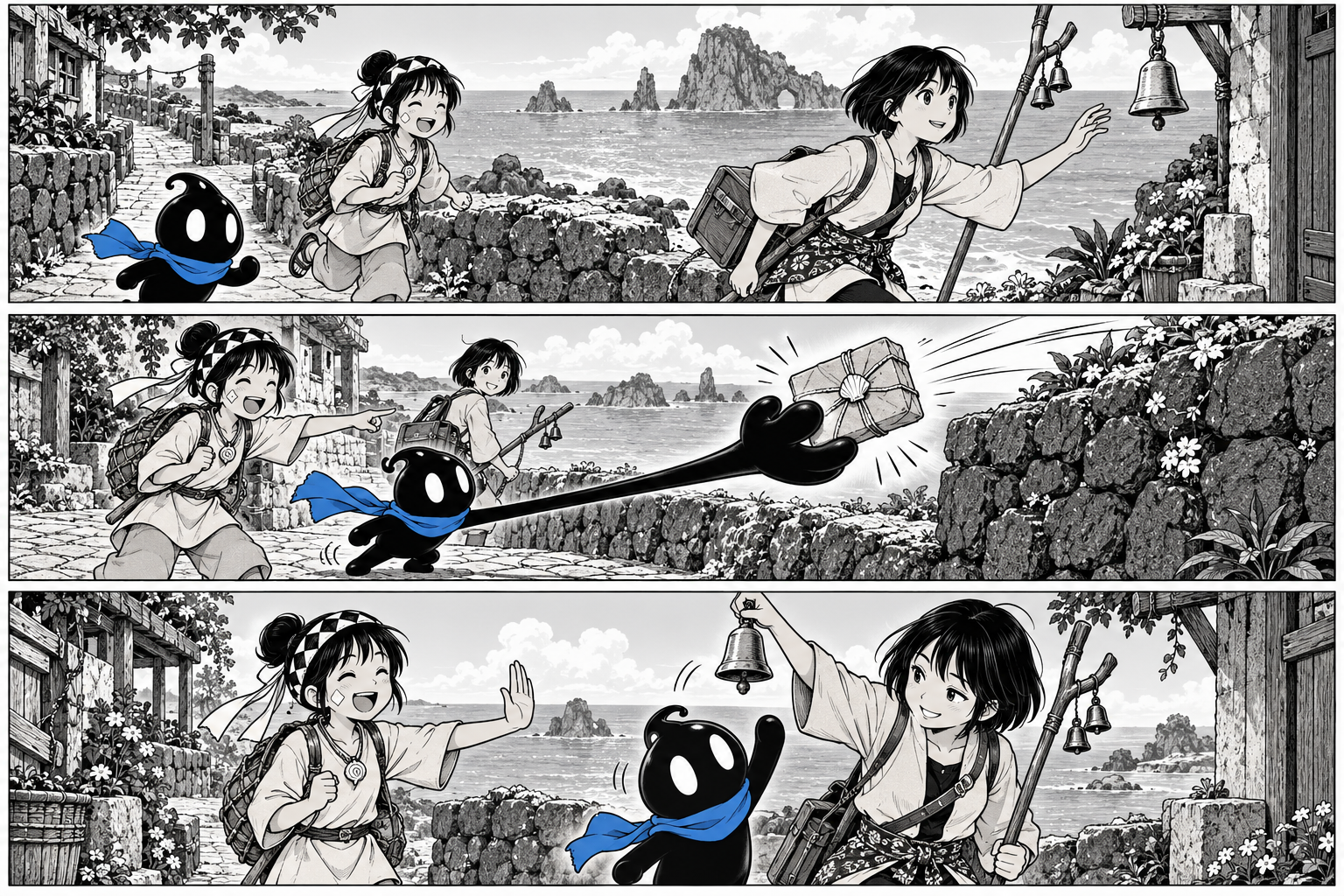
| Element | Writer reference |
|---|---|
| Protagonist | Meok, thirteen, a living Ink raised by a human family; combat, stretching, growing hands and developing unbinding. |
| Co-lead | Sumbi, thirteen, a human spirit user; curious, playful, competitive, gradually learning shared sight, weakness revelation and support. |
| Immediate first goal | Find the marked way home before an unstable crossing and local suspicion leave them stranded. |
| Central conflict | Who may decide what a person is for: family, fear, command marks, religion, history or the person themselves? |
| Human home | A magical island coast of basalt walls, orchards, divers, watch bells and people worth returning to. |
| Other world | A separate dimension inhabited by nonhuman peoples. Its towns have long fought Ink classified as demons. |
| Three eras | Founders Age, Ward Age and Consecrated Age. The first arrival is the Ward Age; later routes reach the other two. |
| Ongoing enemy | The Unfinished Choir promises freedom to rejected Ink while using commands to control them. |
| Tone | Warmth, humour, wonder and inventive combat carry the story; prejudice, captivity, petrification and sacrifice give choices weight. |
Ink origin in one page
- 1Unspoken meaningLove, hope, anger, grief
- 2Boundary currentsGather rare mana impressions
- 3Quiet WellA stable nursery
- 4New personA life of their own
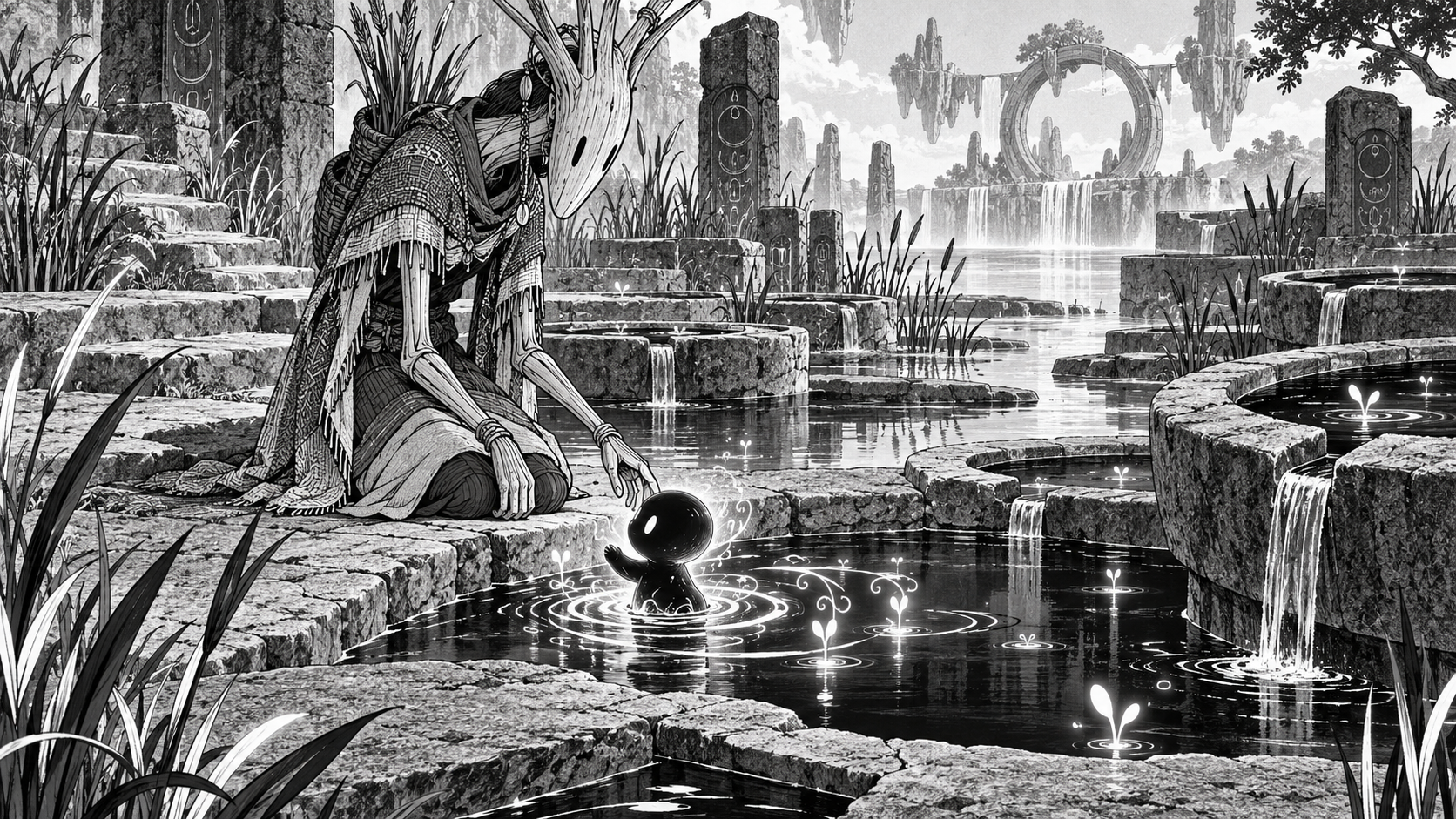
Working author answer. Mana carries an impression when a meaningful word or promise is formed but never expressed. Boundary currents gather that residue from both worlds. In sheltered Quiet Wells, years of accumulated residue can condense around a new life core and become a living Ink.
The newborn is a new person. It is not the speaker's ghost, stolen emotion or reincarnation. Unspoken love, joy and hope contribute alongside fear, anger and grief. Halmang's story about swallowed words preserves part of the truth, but its emphasis on darkness is a fearful simplification.
Ordinary silence does not immediately make a monster. Birth requires a rare nursery, sustained mana and a stable core. Most residue disperses or remains an echo. The earliest Ink predates the Court, Hu and the Choir; no time loop creates the whole species.
Ink bodies can carry and enact meaning. The Court turns this capacity into coercion by forcing command marks into living bodies. Petrification is an imposed stilling command. Meok's ordinary touch is safe. Some independent Ink can also choose violence; freedom from a mark does not guarantee kindness.
The separation matters: ordinary pigment is material; a ghost is a surviving dead person's spirit; a fairy is a living spirit; an Ink is a living person with a core and a changeable body. A puddle or broken-off fist is not automatically another child.
The two worlds and three eras
There are two worlds, not one town with another floor underneath it. Time travel adds eras to the other world. No independent human expedition or established human population preceded Sumbi. Her own later visit to its past can occur earlier on its calendar than her first visit to its present.
The numbers below are writer bookkeeping, not dates characters must recite. H0 is the human present just after Chapter 1. W0 is the other world's Ward Age reached in Chapter 2. The Founders Age is W-360. The Consecrated Age is W+347. The human Great War and Meok's discovery are H-13.
| Route | Matching endpoints | Use |
|---|---|---|
| Lantern threshold | Human H0 and Ward Age W0 | First entrance and ordinary way home. |
| Hearth gate | Ward Age W0 and Founders Age W-360 | Meet Oru and the Wardens as people. |
| Bell gate | Ward Age W0 and Consecrated Age W+347 | Encounter the later religion and consequences. |
| Rising Return | Human H and other world W(H+360) | One-way Ink expulsion; Hu's Great War beast sent at H-13 reaches W347. |
| Falling Return | Human H and other world W(H-360) | One-way expulsion; a retrieval attacker at H-12 reaches W-372 with an order naming Hu. |
| Cradle passage | Founders W-360 and human H-13 | Meok and Sae's original crossing; destroyed after the rescue. |
Hearth and Bell are particular paired doors. Their reverse ends return to the matching Ward Age doors. They are not a spell that repeatedly subtracts or adds centuries from wherever it is cast. Return matrices are one-way Ink expulsions, not doors whose landing sites can be used to reach human H-13. One day spent travelling is one day elapsed at the corresponding home endpoint. No menu of arbitrary dates exists.
Working causality rule: one self-consistent history. The travellers' actions in the past were always part of that history. There are no resets, alternate copies, branching worlds or resurrection by visiting an earlier corpse. Records, murals and prophecies can be wrong. A genuine witnessed event cannot be erased; an alleged historical death can be revealed as a false account. Write choices as voluntary causes of history, without a cosmic force making people behave against their character.
Hu's Great War beast and the heroes take routes with different offsets, so a battle thirteen human years ago can deliver a creature almost alongside their arrival in the Consecrated Age. This is a concrete route relationship, not time running differently whenever the plot needs it.
Writer intake and author answers
A writer agent raised the following sixteen questions before drafting. Each now has an operational answer, a distinction between truth and belief, and a reveal plan. New answers remain marked as working author choices for owner review.
01 Ink origin
Writer question: Where does living Ink originate, and what is true about the swallowed-words story?
Status: Working author answer for owner review
Words and promises charged with feeling can leave mana impressions when their expression or fulfilment is prevented. Boundary waters gather some of these impressions in rare, sheltered Quiet Wells. Over many seasons a well can form a coherent living core and give birth to a new Ink person.
This is new life, not a dead speaker's soul, a reincarnation or a creature made by one person's bad thought. Love, joy, shame, anger and hope can all contribute. Ordinary silence does not create a demon: formation requires sustained accumulation, suitable mana and a stable nursery.
Quiet Wells exist at the other dimension's boundary shores. Ink are one form of life among several there; their origin does not make the entire civilisation an Ink kingdom. Command craft later exploits their bodies' receptiveness to meaning.
Halmang's account preserves a partial truth. Its emphasis on humanity's darkest swallowed words is inherited folklore, not proof that Ink are intrinsically wicked. Normal writing pigment has no living core and cannot become a person merely because someone writes with it.
Belief and misunderstanding: Halmang sincerely teaches the fearful version she inherited.
Many local demon-fighters believe Ink are condensed malice. Others know that peaceful Ink exist but do not know their formation process.
The Choir claims only Ink understand their own birth, while suppressing evidence that contradicts its grievance narrative.
Specialist books record natural Ink births and nonviolent individuals. Religious or military summaries may select only dangerous examples. Meok’s incomplete knowledge is not the limit of the civilisation’s knowledge.
Reveal: Chapter 1 supplies Halmang's incomplete account.
An early encounter supplies a harmless Ink whose conduct challenges the moral classification.
A later Quiet Well visit shows a living nursery and the impressions of an unspoken kindness. Historical records then explain why the darker account spread.
02 Personhood and death
Writer question: Are Ink people, and how do their bodies, fragments, senses and deaths work?
Status: Working author answer for owner review
A natural Ink has an individual core, experiences emotions normally and acquires its own memories through living. Source impressions do not dictate its personality. It may remember a sensation without possessing the originating speaker's identity or biography.
The body is living Ink organised around that core. An attached limb can stretch and reshape. Detached droplets are tissue, not independent people or automatic offspring. Recoverable body matter can be gathered back while the core survives; a destroyed core means irreversible death.
Ink cannot taste human food as humans do. They can perceive mana and resonance flavours that humans cannot. This is a sensory difference, not a lack of affection, joy or moral personhood. Meok can honestly enjoy breakfast company while still wanting to experience the food's taste.
Healthy Ink mature and age slowly; some survive for centuries. They are not immortal. Body damage, core injury and exhaustion remain meaningful. A controlled surface film can resist brief wetting, but prolonged dilution or turbulent water can disperse an exhausted body. Water is neither a universal instant kill nor an unlimited safe refuge.
Ghosts are the surviving spirits of formerly living individuals. Fairies are independent spirits. Neither is an Ink fragment, and healing or unbinding cannot restore a destroyed core or resurrect a dead person.
Belief and misunderstanding: Meok knows his own emotions are real; he does not begin with a scientific account of his core or species.
Some locals mistake detached Ink for reproducing vermin and use that fear to justify harsh disposal.
Sumbi learns to distinguish a person, a spirit and an imposed command by observing different behaviour, not by receiving an infallible species detector.
Reveal: Ordinary meals and play establish Meok's real pleasure before the taste limitation becomes a serious pursuit.
Combat visibly establishes attached reach, fatigue and recovery.
A later injury or failed rescue establishes the core's mortal limit before a major death depends on it.
03 Corruption and restoration
| Behaviour | Can act without a command | Under an imposed command |
|---|---|---|
| Not choosing harm | An independent Ink neighbour | An unwilling war-form victim |
| Choosing harm | An unbound attacker | A willing enforcer who is also bound |
Writer question: What turns living Ink into a petrifying enemy, and can it be reversed?
Status: Working author answer for owner review
Command craft imposes structured instructions on a living Ink core and body. A war form combines coerced shape, behaviour and an attack command. Petrification is a binding instruction that arrests the target's living mana and progressively fixes contacted tissue into stone. Ordinary Ink touch is safe.
Command-bound is not synonymous with morally evil. Some bound Ink resist; some commanders choose cruelty; some unbound people choose violence. Releasing a command does not automatically make a willing antagonist kind.
Petrification begins at exposure, spreads while the binding remains active and can preserve an intact victim alive. That preservation is not comfort: awareness may return intermittently while the person cannot move. Physical destruction of vital stone tissue can still kill. Removing the cause does not regrow damage or resurrect a victim.
A command-bound Ink can recover if its core survives and the imposed structure can be safely dismantled. Breaking a superficial mark is not always sufficient: old commands may be embedded in several layers. Meok's extraction creates a difficult possibility of release, not a guaranteed cure.
Belief and misunderstanding: Meok wants to believe every corrupted Ink can be brought back. The story tests the time, danger and limits of that belief.
Experienced defenders have seen genuine deaths and cannot safely assume every attacker can be rescued during a fight.
The Choir calls commands necessary discipline while describing other institutions' bindings as slavery.
Reveal: Chapter 1 establishes harmful contact, living stone victims and Meok's safe ordinary contact.
An early lesser enemy shows an external command mark and a specific exploitable opening.
A later release saves one individual; a separate failure establishes the limit before army-scale stakes.
04 Meok’s exception
Writer question: Why is Meok exceptional if other natural Ink also have no Court seal?
Status: Working author answer for owner review
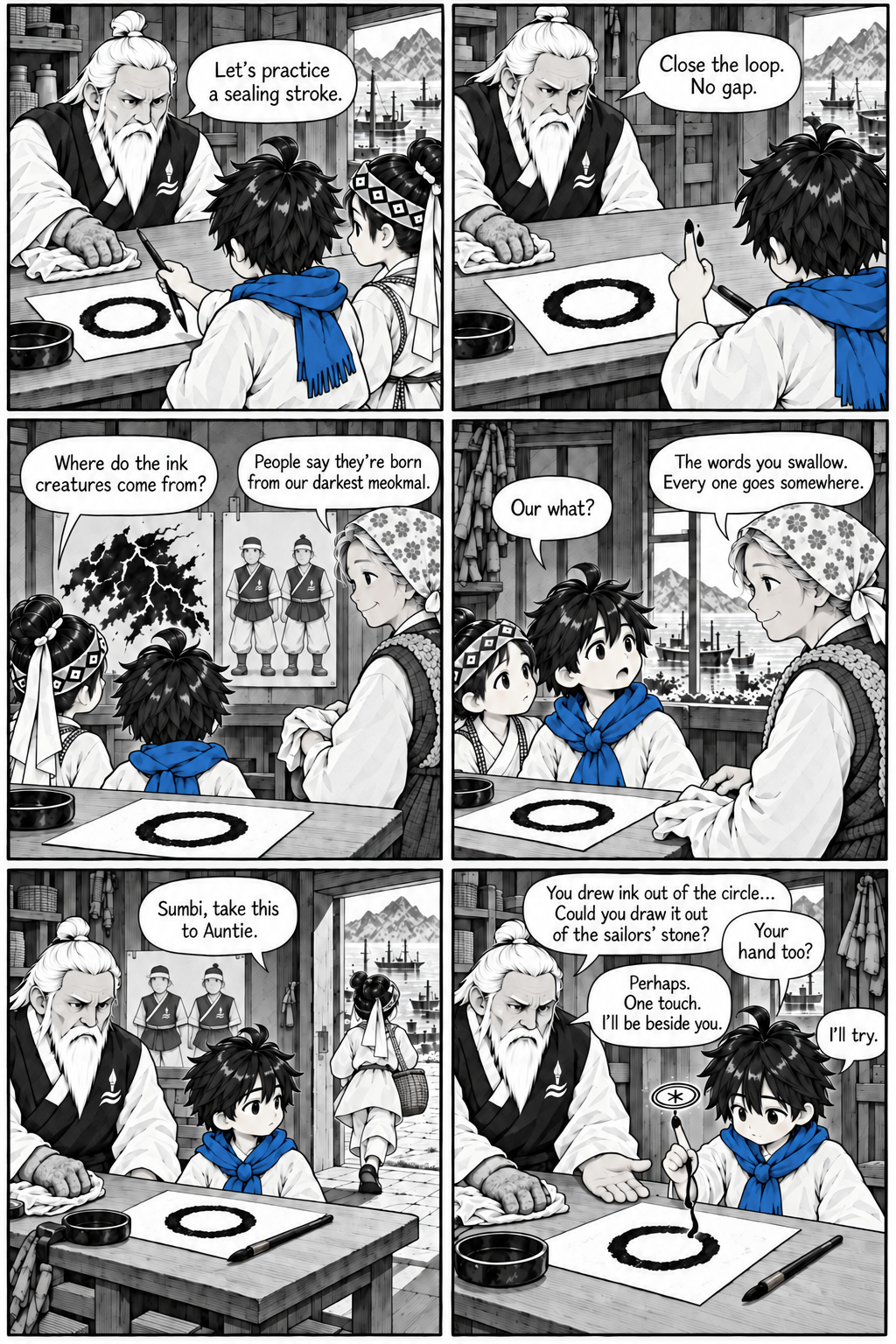
Most natural Ink have stable, closed cores. Meok formed where two differently timed nursery currents briefly met. His rare open core can admit and loosen an imposed pattern rather than only carry or resist it. The phenomenon predates Court ownership and was not created by a rescuer removing a seal.
No seal means Meok has not been successfully claimed by Court command craft. It is a useful diagnostic clue, not the complete cause of his ability. Other free Ink exist and do not automatically share his extraction power.
Extraction initially draws foreign binding Ink into Meok. The intruding pattern disrupts his body's organisation: reach becomes unreliable, boundaries blur, pain and exhaustion increase, and continued exposure risks damage to his core. He needs an accessible seam, concentration and a controlled way to shed or discharge the extracted binding.
He develops precision through practice and collaboration. Sumbi can expose a real seam but cannot do the extraction for him. Meok remains the active fighter and can refuse a dangerous attempt. Royal descent is not required; the working story does not make him a hereditary prince.
Belief and misunderstanding: Hu recognises unusual potential but does not know the nursery event or promise a cure.
Meok initially interprets being called a hope as both affection and pressure.
Seo later wants a controllable exception; freed Ink may want a liberator. Neither claim owns Meok's body.
Reveal: Preserve the Chapter 1 diagnostic, extraction and frightening refusal in that order.
A later encounter shows that another unmarked Ink cannot do the same thing.
The Quiet Well record explains Meok's formation only after the ability and its costs matter personally.
05 Chronology and first arrival
- 1Human presentTheir starting home
- 2Ward AgeFirst arrival
- 3FoundersLater Hearth visit
- 4ConsecratedLater Bell visit
Writer question: How many worlds and eras exist, and where does Chapter 2 arrive?
Status: Working author answer for owner review
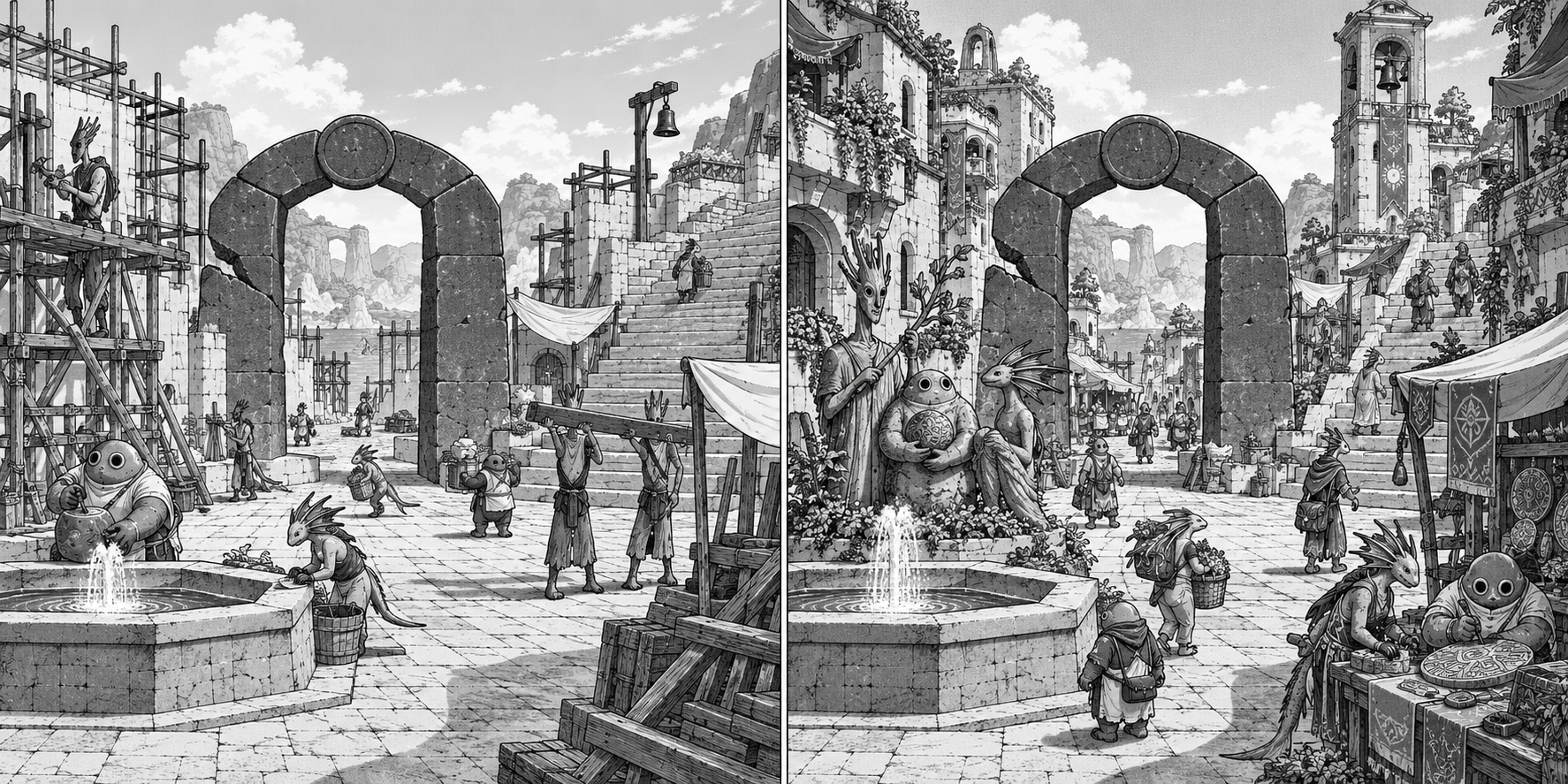
There are two distinct dimensions: the human coast and the nonhuman other world. The other world is encountered at three anchored eras: Founders, W-360; Ward Age, W0; and Consecrated, W+347. Human present is H0. The Great War, Meok's capture and his discovery by Halmang occur at H-13.
The first Chapter 2 crossing reaches the Ward Age at W0. The Lantern route pairs human H(t) with Ward Age W(t). The Hearth route pairs the central Ward Age anchor W(t) with its Founders endpoint W(t-360). The Bell route pairs the central Ward Age anchor W(t) with its Consecrated endpoint W(t+347).
These are specific paired anchors, not arithmetic spells. Crossing back from Founders returns to the matching central anchor; it does not subtract another 360 years. There is no accessible Hearth or Bell destination selector allowing arbitrary dates.
Each endpoint advances at one day per day of experienced travel. Spending three days away means three days pass at home. The relative offsets stay fixed. Old structures may persist across eras, but route availability, inhabitants and damage differ.
Era labels are relative years. The cradle crossing, Meok’s capture, Ryeon’s return and Sae’s death precede the protagonists’ first Hearth arrival within the Founders season. They meet Oru and the Wardens alive; surviving witnesses and records tell them about Sae.
Belief and misunderstanding: Sumbi initially thinks she has entered a strange place, not a different date.
Ward Age residents call the routes by their destinations and local histories; most have not travelled all three.
Future religious authorities know that earlier eras are accessible and control public explanations of that fact.
Reveal: First establish the other dimension and a readable route home.
A second era supplies a physical contradiction: an intact building previously seen ruined, or a living person known only as a legend.
A route ledger and repeat journey establish the fixed offsets before deliberate multi-era planning.
06 Time causality
- 1EventPeople make a choice
- 2RecordA witness preserves part
- 3DoctrineAn institution interprets it
- 4DiscoveryThe pair tests the claim
Writer question: Can time travel rewrite history, undo death or create unlimited retries?
Status: Working author answer for owner review
The story has one self-consistent history. There are no reset lives, discarded branches or automatic retries. A witnessed death remains a death. Characters can discover that a report, statue or religious account was false; they cannot erase an event actually established by reliable direct observation.
The future contains the consequences of the protagonists' choices because those choices happened. It does not magically compel their motives or announce a required sacrifice. A record claiming Sumbi died can be exposed as a lie while Sumbi still chooses how to help people.
Travel moves a person; it does not create a replacement copy. Current paired routes do not reach human H-13 or permit a return to an earlier moment of the same lived journey. A younger or older historical person may be encountered at the appropriate endpoint, but the route network supplies no accessible second Sumbi or Meok to exchange for the protagonists.
No important origin is a bootstrap with no first maker. Native Wardens independently develop command basics in Founders time. Later travellers steal, improve and transmit those methods; their future theft does not create the original discovery.
Belief and misunderstanding: Some priests equate a surviving record with a command from fate.
Sumbi distinguishes an observed event from somebody's interpretation of it.
Meok may hope that reaching an earlier era could save Hu, but learning the actual routes and limits must close that hope honestly.
Reveal: Show elapsed days and the absence of a reset on the first successful return.
Expose one minor false historical claim before a major religious claim depends on the distinction.
State that the lost cradle route cannot be used to reach Hu's war before the pair considers altering Meok's infancy.
07 Hu’s banishment and duty
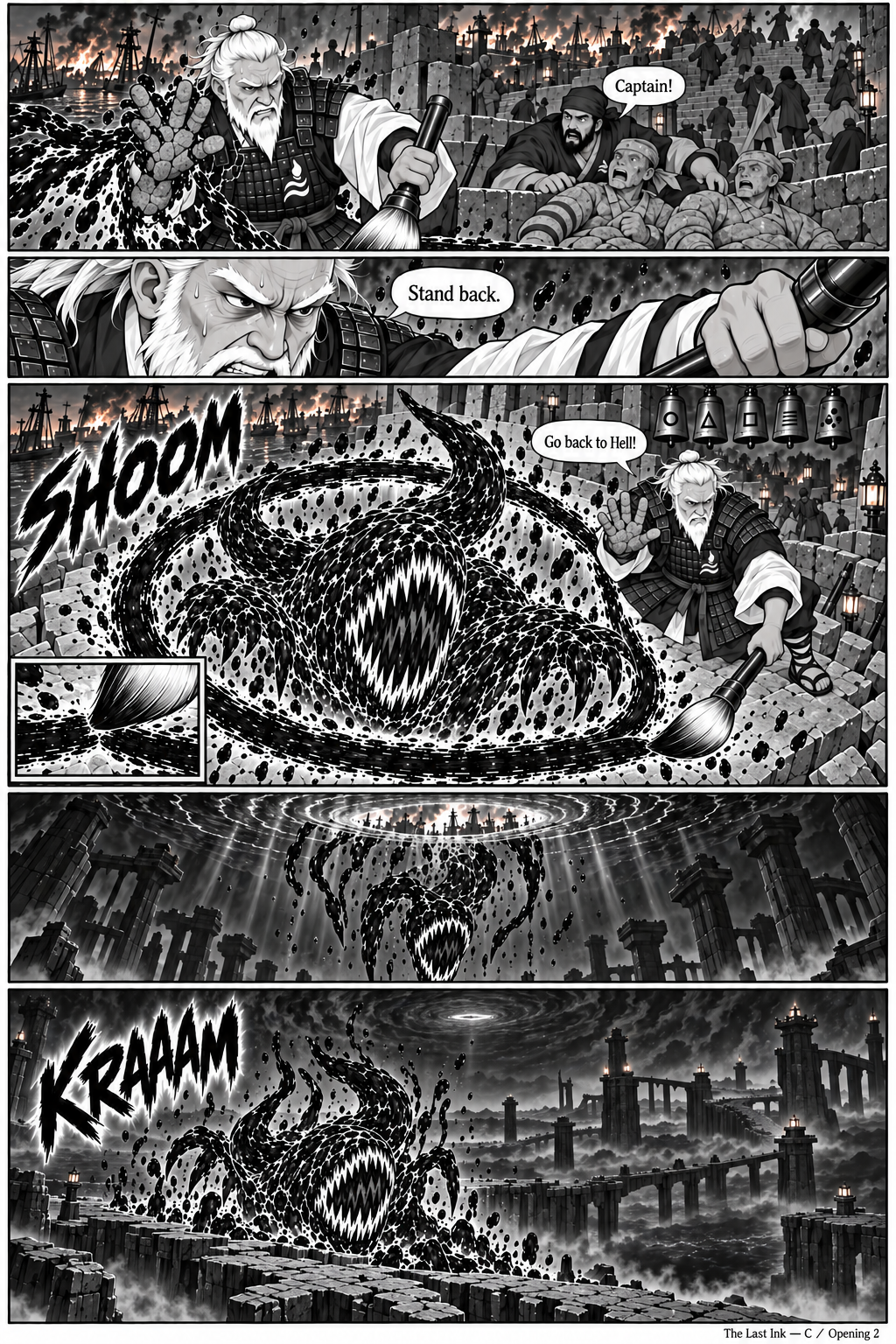
- 1Hu’s shoreImmediate lives saved
- 2Return strokeOne-way expulsion
- 3Another eraThe threat arrives alive
- 4Dol’s watchLocal defence continues
Writer question: What does Hu's banishment do, and how could a responsible protector remain ignorant of its destination?
Status: Working author answer for owner review
A completed ordinary circle contains a threat locally. A full Return matrix additionally needs an active threshold and a destination glyph. Hu inherited both Return matrices and practised them as wartime emergency techniques. Its glyph encodes a route he was taught to identify as expulsion, not a date he could read.
Rising Return sends human H(t) to otherworld W(t+360). Thus Hu's Great War banishment at H-13 reaches the Consecrated era at W+347. Falling Return instead reaches W(t-360). Neither operation guarantees the target originated at that destination: the human phrase 'Go back to Hell!' is an inherited belief.
Hu sees a living threat removed and cannot observe the far shore. Military teaching, missing records and apparently successful immediate protection reinforce his mistaken belief. He does not knowingly export suffering or choose death instead of warning people.
Before dying he leaves local containment procedures, warning bells, watch rotations, supplies, keys and his incomplete Return records to Dol. He records uncertainty about what lies beyond. Dol competently maintains local defence; his festival circle does not imply he has decoded temporal travel.
Hu refuses to surrender child Meok for further dangerous experiments. That refusal and the later consequences of real banishments are combined by the future faith into a false accusation of deliberate betrayal.
Return matrices are one-way expulsions of living Ink and attached inanimate cargo. Their landing sites are not reverse traveller gates. Human passengers cannot ride a Return stroke; human travel needs a willing spirit and a paired threshold.
An additional author-history event occurs at human H-12, after Hu has sheltered baby Meok: a Court retrieval attack carries a sealed recovery order naming Hu and his refusal to surrender the unmarked child. Hu uses Falling Return on that attacker and its attached document case. It lands at W-372, leaving a dated casualty report and Court record long before the future religion. Hu does not know that he has sent it centuries backward.
After the war the Court lacks the force and local legitimacy to overrule Hu’s ward command. Its retrieval attack fails; Hu retains the child, records the demand and strengthens the watch. His refusal is an active protection decision, not unprepared acceptance of a coming danger.
Belief and misunderstanding: Hu believes the technique sends hostile Ink away from people, to the place his teachers called Hell.
Dol knows Hu's caution and unfinished questions, rather than a secret complete route atlas.
Consecrated survivors correctly remember a terrible arrival but are taught that Hu knowingly broke a protective oath.
Reveal: Keep the Chapter 1 banishment and responsible watch succession.
The pair later recognise Hu's distinctive stroke scar on a recently arrived future threat.
Hu's surviving notes and the destination matrix prove ignorance of the date without denying the people harmed.
08 Water travel and return
- 1Fairy contactActivates the prepared mark
- 2CrossingIncoming circuit works
- 3Failed returnReverse relay is missing
- 4RepairRecover its keyed part
- 5HomeHold contact and cross
Writer question: What activates water travel, selects its destination and permits return?
Status: Working author answer for owner review
Water reveals a threshold where an installed anchor, an intact route matrix and a viable paired endpoint coincide. Ordinary puddles have none of these properties. The fairy's sustained accord with the prepared mark activates the route; the route's construction fixes the destination.
Sumbi uses the fairy to inspect a missing-water outlet. Contact accidentally completes the dormant Lantern circuit. The reflection changes before the shallow floor opens. Meok reaches for her and crosses with her. Her gasp breaks concentration; fairy contact ends and the opening closes.
A deliberate return requires finding the matching home anchor, restoring the interrupted mark and maintaining fairy contact until the crossing finishes. Carried belongings and companions can cross within the open boundary; large attacks or moving armies require a larger, prepared installation rather than Sumbi opening a convenient escape hole.
The shell carries a recognisable trace of the old cradle route and its material origin. It can help identify provenance and confirm a related anchor. It cannot select any era, create a new endpoint or replace the fairy's activation.
Once an endpoint is destroyed, remembering its pattern is insufficient. The old cradle route to H-13 is physically lost and is not rebuilt by the protagonists. A successful crossing cannot restore a destination that no longer exists.
At the first Lantern arrival, the incoming circuit is viable but the reverse relay is damaged: the local Choir theft at Counterweight House has removed its keyed component. Restoring fairy contact cannot energise that missing circuit. Show the fairy following a line that dies at the break during the first failed return attempt. Ordinary closure does not break a gate; this particular pre-existing fault requires repair and also causes the finite water seepage.
Belief and misunderstanding: Sumbi first thinks she failed at an ordinary scouting task.
Meok recognises the shell's comfort before understanding its origin.
Experienced ward specialists understand prepared gates but cannot open them anywhere or infer every temporal offset from the material alone.
Reveal: Stage trigger, changed reflection, fall, rescue attempt and closure as visible consecutive actions.
Let the immediate failed reopening prove that a gesture alone is insufficient.
End the first otherworld arc with the pair deliberately restoring and using the same home connection.
09 Meok and the shell
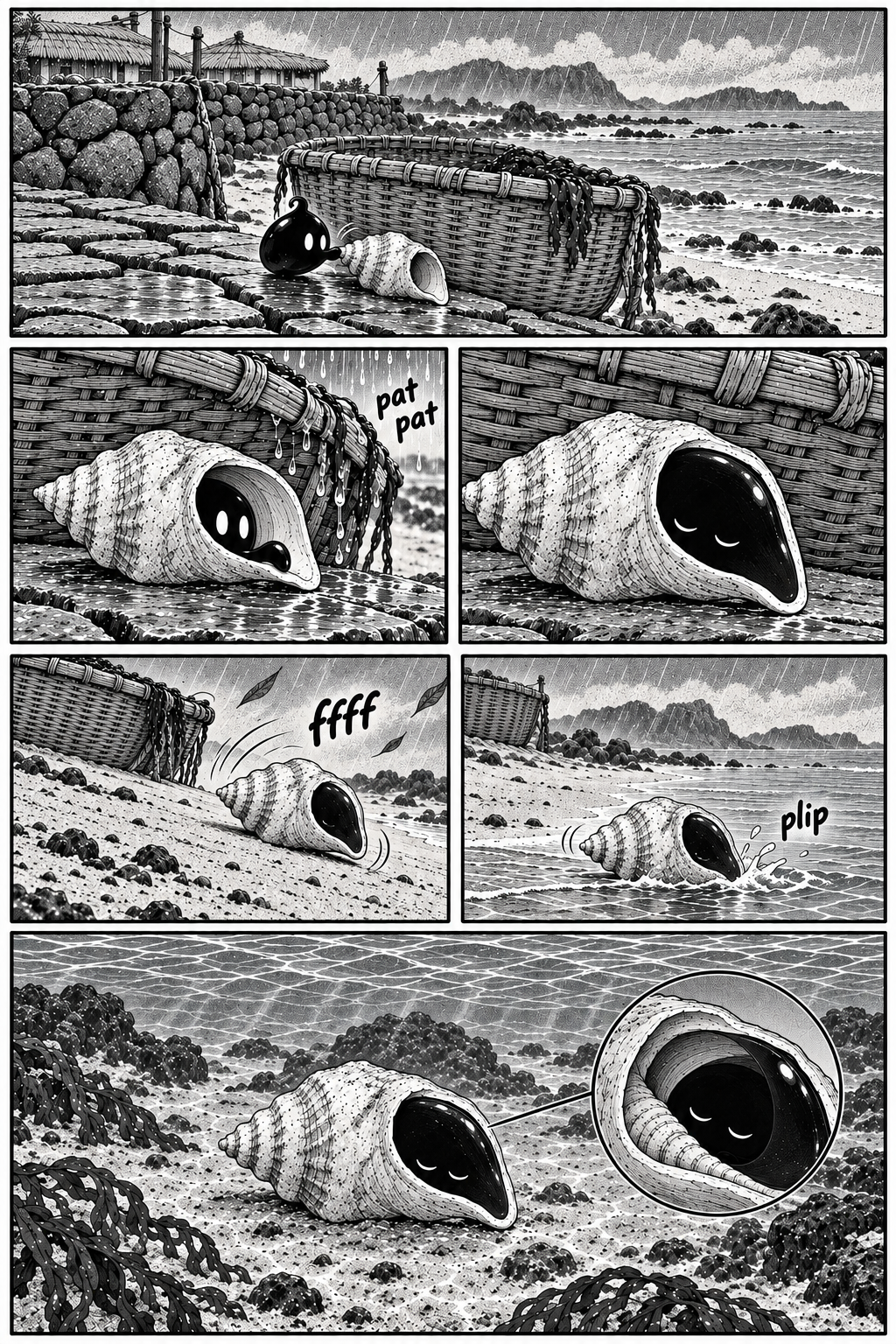
- 1SaeSends Meok through water
- 2CourtConfiscates the shell
- 3RescueMeok shelters in it again
- 4Halmang + motherKeep and repair it
- 5SumbiCarries it back
Writer question: Who sends Meok, captures him and rescues him, and how does his shell reach Sumbi?
Status: Working author answer for owner review
Meok forms in a Founders-era Quiet Well where two differently timed currents meet. Sae, an Ink known for a convincing human-shaped mask, discovers the unusual child and takes him from a planned command claim. Sae sends Meok in a boundary shell through a briefly open cradle route from W-360 to human H-13, hoping to place him beyond the claimants' reach.
Ryeon is already operating in Founders time. He intercepts the cradle route, reaches H-13 and captures Meok into the vessel seen in Chapter 1. The confiscated shell is placed among shore cargo. Ryeon supplies the human Court with improved command and war-form methods; it already possesses basic containment from earlier displaced Ink and objects.
Sae follows, uses a human-shaped mask to move through the human shore and becomes the anonymous black-handed rescuer with the broken-circle wrist mark. During the battle distraction Sae frees the already living Meok from the vessel on the dry quay. Ryeon returns through the cradle route before Sae closes it.
Meok escapes back to the same shell among the shore cargo. Preserve the approved wind, basket and shallow-water sequence through which Halmang finds him. Sae destroys the cradle connection while fleeing the remaining pursuers and dies. Their mask was a bodily disguise, not biological humanity.
Ryeon survives through the intervening centuries and later serves Seo in the Consecrated-era Choir. His longevity does not require a secret journey from the future into H-13.
Halmang keeps the shell. After Hu's death, she entrusts it to Sumbi's sea-diver mother, who repairs it into a wearable horn and gives it to her daughter. Sumbi wears it from then on. Her mother has never crossed dimensions, and the gift is not hereditary.
Belief and misunderstanding: Meok has no reliable infant memory that explains this complete sequence.
Halmang knows where she found him and how the shell entered the family, but not the cradle route or Sae's whole identity.
Locals remember Sae as the First Mask who sought humanity and never returned; the rescue has been lost from the public legend.
Ryeon knows the interception and rescue, but initially mistakes Meok's unusual body for a useful controllable anomaly.
Reveal: The shell’s recognised material gives the first provenance clue.
Founders witnesses and Sae’s own surviving notes supply personality and motives. Sae has already departed on the destroyed cradle route; the heroes do not meet Sae alive through that closed passage.
Matching the marked left wrist, confiscation record and lost cradle matrix resolves the Chapter 1 rescue without redrawing it.
10 Knowledge across eras
Writer question: Who knows about time travel, and why has the truth not become common knowledge?
Status: Working author answer for owner review
Hu knows containment and inherited Return execution, not temporal coordinates. Dol knows local defence, Hu's doubts and the preserved records. The wartime human Court understands ownership and containment, but most officers do not know that the imported Return glyphs encode dates.
Ryeon understands specific crossed routes and keeps that knowledge valuable. Seo later knows the Bell route and selected breach matrices through Ryeon and recovered records. Neither possesses an arbitrary-date travel machine or omniscience about future choices.
Local keepers know the anchor nearest their station; specialist records identify more of the network. Travel is scarce because endpoints are protected, damaged, geographically separated or institutionally controlled. Households, schools and libraries preserve histories and practical Ink knowledge. Complete temporal matrices remain specialist information.
Returning Ink can carry testimony, but most cannot activate a gate alone, many hostile arrivals are command-bound, and surviving witnesses use different local dates. Prejudice, lost records and deliberate suppression prevent their accounts from becoming a coherent public chronology.
Future Sumbi imagery is retrospective religious history, not a message from a god. It describes her later Founders-era evacuation, distorts her departure into death and uses her actual shell and appearance as sacred identifiers.
Ink has been studied for centuries. Patrol manuals, medical casebooks, nursery observations, dated arrival ledgers, religious commentaries and Ink-authored books survive in libraries and repair guilds. Scholars can know more than the protagonists. Institutions argue over personhood, dangerous forms and interpretation; the entire truth is not missing because nobody kept books.
The Order’s old Hu accusation rests on the H-12 Falling arrival at W-372 and its recovered Court order, copied by local record keepers. His H-13 Rising beast arrives at W347 only recently; it confirms and inflames the already inherited accusation rather than somehow creating centuries of religion overnight.
Belief and misunderstanding: Ordinary humans believe the hostile destination is Hell.
Ordinary otherworld residents know dangerous arrivals occur, but disagree about the human agents' intentions.
The Order describes historical repetition as destiny and presents specialist knowledge as privileged revelation.
Reveal: Introduce local dates and a keeper's practical knowledge before explaining the whole chronology.
Let independent accounts disagree in a way that can be checked against an object or scar.
Reveal the Order's manipulation after showing that its followers have real evidence and genuine losses.
A captain identifies a creature from a worn field guide. Later compare a nursery register, an arrival ledger and a religious retelling of the same events. Books reveal sources and disagreement rather than an omniscient final encyclopedia.
11 Religion and Hu the traitor
Writer question: Why does a future religion call Hu a traitor and treat Sumbi as destined?
Status: Working author answer for owner review
The Order of the Last Bell grows around communities harmed by Return arrivals and later protected by costly wards. It maintains shelters, hospitals, repairs and mourning rites. Its kindness and the losses that built it are real.
The Order correctly preserves evidence of monsters arriving with Hu's stroke. Its official account falsely says Hu knowingly violated a two-world protective oath. It also portrays his refusal to surrender Meok for experiments as choosing a demon over suffering families. These claims combine actual consequences with invented intent.
In Founders time Sumbi later holds a gate open long enough for an evacuation and leaves alive with Meok. Centuries later the Order turns her disappearance from that place into martyrdom, treats her shell as a sacred identifier and claims her gift obliges her to return permanently as a living anchor.
A sustained living anchor is a cheap, convenient way to keep a major ward stable, not the only possible solution and not a magically necessary death. Distributed mana maintenance, repaired route infrastructure and costly shared labour can replace it. Authorities hide or neglect those alternatives because they transfer expense and control to the institution.
The Order can obstruct departure by controlling anchors, withholding repairs and claiming custody of Meok. Some members knowingly coerce; others believe that keeping Sumbi safe and available is compassion. No supernatural force compels her consent or guarantees the Order's version of events.
Use two distinct pieces of evidence: the old W-372 report and recovery order support the identity and refusal; the fresh W347 creature supports a new attack. Neither proves Hu knew the destinations or swore the oath the Order attributes to him.
Belief and misunderstanding: Many followers love their saint sincerely and expect a joyful welcome to be enough.
A bereaved defender may hate Hu while honestly helping Sumbi.
Sumbi rejects ownership of the gifted without dismissing the people genuinely depending on protection.
Meok can defend Hu's care while recognising that his saved village was not the only community harmed by the war.
Reveal: Show a charitable action and Sumbi's shrine before revealing the coercive expectation.
Let 'Hu raised me' change a room's behaviour before anyone explains the doctrine.
Past participation and original records disprove martyrdom and deliberate betrayal, while the repair problem remains real.
12 The Choir and the stamp-holder
- 1SeoBelonging and liberation
- 2RyeonCommand marks and control
- 3FollowersWilling recruits and bound bodies
- 4MeokUnbinding threatens ownership
Writer question: Who are the recurring villains, what do they want, and what can they actually do?
Status: Working author answer for owner review
Ryeon is the Chapter 1 stamp-holder: an Ink forced into a durable humanoid war shape and trained in command craft. He survives from Founders time into the Consecrated era. He believes autonomous Ink will always be hunted unless someone commands enough power to make persecution impossible. His answer reproduces the ownership he suffered.
Seo leads the Unfinished Choir in the Consecrated era. He offers rejected Ink shelter, status and revenge against cages and forced returns. He wants to seize the Bell network and preserved Warden records, direct hostile forms into opponents' settlements and establish a protected domain under his command.
Ryeon supplies technical control and enforces commands. Seo supplies a political promise that wins willing recruits as well as coerced bodies. The Choir does not rule all native peoples or represent all Ink.
In an early arc their agents seek a command ledger and an intact anchor component; they cannot appear in every era without using known, accessible routes. Their recurring advantage is preparation and stolen infrastructure, not unlimited time travel.
Meok threatens their method because developing unbinding can release imposed commands. Seo wants him publicly as proof of liberation and privately as an obedient exception. Sumbi threatens the future Order's authority separately; the Order and Choir can exploit one another without becoming one secretly identical faction.
Ryeon passes 707 native-calendar years between Founders W-360 and Consecrated W347. Natural Ink can live centuries while a stable core is nourished. The younger Ryeon continues through the local chronology after the cradle episode; the future Ryeon stays in the Consecrated era and uses agents elsewhere during this season. No scene brings his two ages together or creates an extra person.
Belief and misunderstanding: Seo's recruits can believe resistance and obedience are the price of survival.
Ryeon considers Hu sentimental and Sae's rescue a dangerous theft of strategic power.
Meok recognises the Choir's grievance while opposing its right to own other Ink.
Reveal: Introduce a changed command form and stolen component before a villain explains the whole plan.
Reveal Ryeon's stamp and silhouette connection before his complete longevity and childhood history.
Give a willing Choir recruit a persuasive reason to join before exposing Seo's coercion.
13 Peoples and daily life
Writer question: Who lives in the other world, and how can a writer stage ordinary life and distinct characters?
Status: Working author answer for owner review
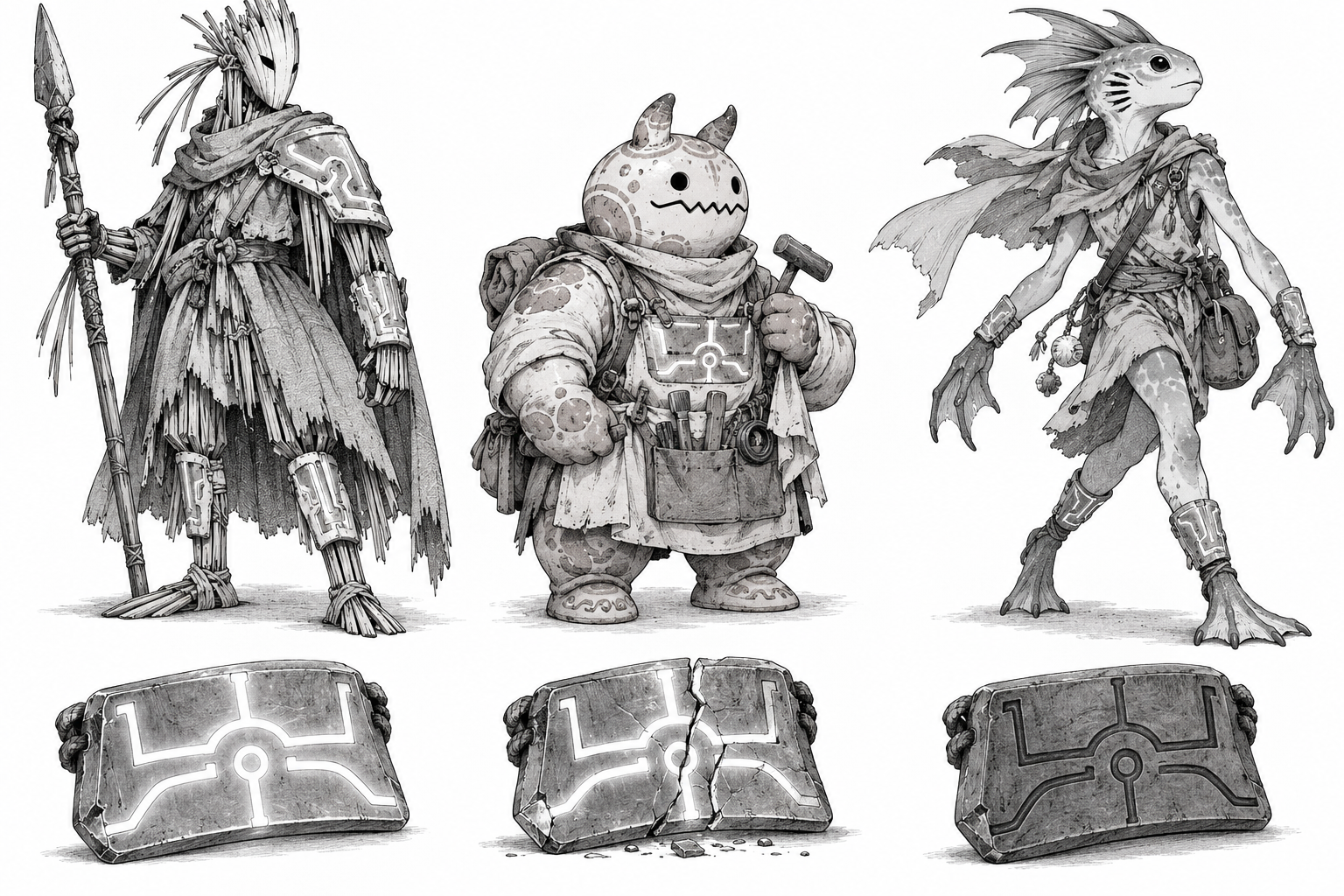
Reedkin are living-wood people with varied faces, leaf growth and flexible hands. Moru keeps the approved rounded pale wood face and three short vertical grove marks. Warm eyes, woven leaves and an open-lamp ward badge distinguish him from command-bound war forms with black binding tears, rigid command faces and jagged closure marks.
Kilnfolk have compact living bodies with warm glazed plates and visible joints. They specialise in fired ward plates, repair yards and portable heat. Their mineral appearance does not make them immune to a binding that arrests living mana.
Tidekin have webbed hands, translucent fin crests and adaptations for boundary pools. They cultivate salt gardens, pilot waterways and maintain submerged anchors. Mixed households and apprenticeships exist; a craft is a tradition, not a species-exclusive destiny.
Ward Age settlements have market terraces, repair shops, kitchens, bathhouses, nurseries, watchposts and lamp-marked roads. Families trade food, tools and ward maintenance. Civilians wear a few protective plates suited to work; patrols carry more complete, maintained armour. Shared engraved channels give the civilisation a recognisable appearance without identical costumes.
A common Shore Tongue reached both dimensions through earlier Ink travellers and exchanged objects. Sumbi understands everyday conversation in an unfamiliar dialect, but cannot automatically read old command notation or specialised religious records. This does not imply an earlier human visit.
A human child is unprecedented, not automatically recognised as a known visiting species. Her spirit accord and unfamiliar flesh are investigated. Practical hospitality can welcome an apparently unbound child while a safety station restrains Meok as a suspected demon. Individual residents differ; acceptance is not the entire world's unanimous response.
Belief and misunderstanding: The guide regards ward upkeep as ordinary work and resents having a whole people mistaken for attacking creatures.
Patrols have legitimate exposure risks but can overgeneralise them to every Ink.
Sumbi initially misreads similar silhouettes and learns identifying details through action.
Reveal: Show a meal, a repair and an actual patrol procedure rather than an encyclopaedic welcome speech.
Stage the guide and first hostile form together so their different motion, eyes and marks are unmistakable.
Let a civilian's damaged protective plate connect economy, danger and daily appearance.
14 Magic and its costs
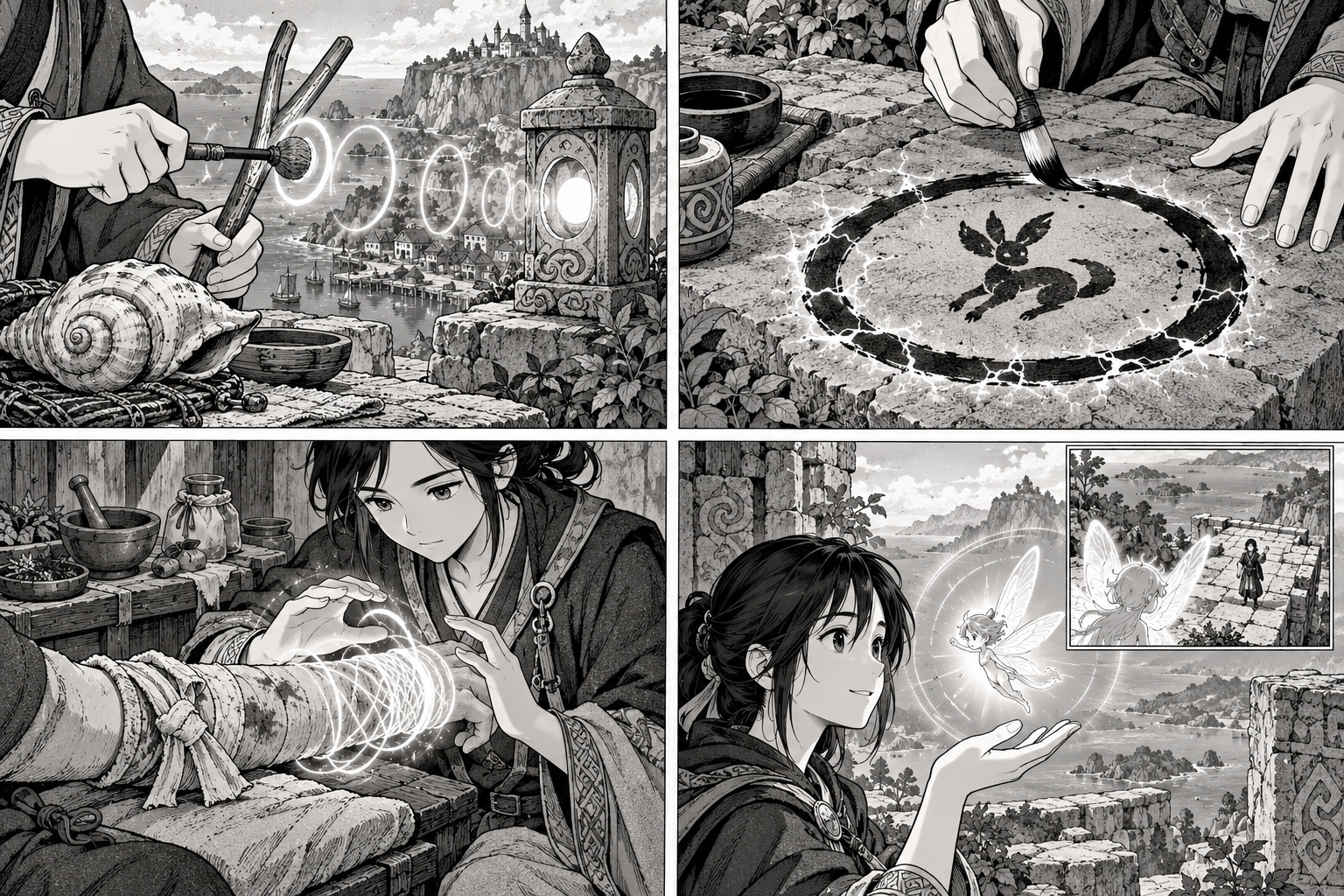
- 1ReserveMana is finite
- 2PreparationA source and connection
- 3EffectA visible action
- 4StrainA cost and recovery
Writer question: What are the operational limits of mana, armour, healing and unbinding?
Status: Working author answer for owner review
Living bodies restore their mana through rest, nourishment and time. Prepared resonance materials can store charge and specialists can transfer it through compatible channels. A spell spends a finite reserve; stronger effect, greater duration and more targets increase strain. Mana is not a stock of expendable dead people's souls.
Engraved armour resists low-level petrifying binding exposure. Impact and contact consume charge. Cracked plates or broken channels create local gaps; dimming gives a visible exhaustion warning. Physical repair and mana restoration are different jobs. A stronger or layered command can overwhelm an intact charged suit.
Armour neither cures established stone, nullifies an ordinary stretchy punch nor protects every unplated part forever. A ward technician can protect a settlement against familiar lesser attacks without becoming invulnerable to a new war form.
Sumbi starts with one fairy viewpoint at a time, leaving her body vulnerable. Weakness revelation requires observing a real pattern or exposed seam and does not open the guard itself. Initial healing needs contact and uninterrupted concentration to mend a manageable wound; it cannot restore limbs, erase corruption, reverse petrification or resurrect.
Meok's extraction adds a second hazard to ordinary combat fatigue: foreign binding disrupts his core organisation. The pair must create a safe opening, choose whether to attempt release and leave recovery time. A fight can be won by containment or escape without completing a cure.
A neutralising ward has prepared geometry, limited reach and breakable channels. It can hold an Ink body or limb within its field, including harmless Meok. It is not a remote switch that erases a species.
Belief and misunderstanding: Sumbi can learn a real useful technique without having answers to every injury.
Meok's first extraction success may tempt him to overestimate repeatability.
An experienced armour wearer respects upkeep and still fears a stronger command.
Reveal: Show a charged plate protecting against one lesser attack, then its damaged or depleted state.
Demonstrate a specific spell's preparation, connection, effect and end before relying on its limit for suspense.
Show a stronger threat breaching familiar protection through a readable cause.
15 Character state and secrets
Meok
- Wants
- Human life and belonging
- Believes
- The corrupted deserve a chance
- Keeps private
- His search for human taste
- Cost
- Trying too hard to prove he can save someone
Sumbi
- Wants
- An adventure she chooses
- Believes
- Spirits must be allowed to leave
- Keeps private
- Her diving plans from her mother
- Cost
- Releasing someone she has grown to need
Writer question: What do the protagonists want, believe and conceal at the start of the otherworld story?
Status: Working author answer for owner review
Sumbi immediately wants to return home and explain the missing water; she also wants to understand the extraordinary place she found. Her broader pleasure is choosing an adventure of her own. Her mother's diving restriction comes from real sea danger and protective love, not secret knowledge of prior human expeditions.
Meok immediately wants Sumbi safe and both of them home. He also hopes a world familiar with Ink may understand him or offer belonging. Being restrained as a demon injures that hope without erasing his curiosity or kindness.
Sumbi's guiding belief is that a spirit must be allowed to leave even if living people need its service. At first she withholds the extent of her own diving plans from her mother and later has to confront the resemblance to protection through secrecy. The earlier optional hidden ghost-friend episode is not required canon.
Meok's guiding belief is that corrupted Ink deserve a real attempt at restoration. His later secret is a private search for a way to experience human taste and perhaps humanity, while fearing his kin will interpret the wish as rejection. His Chapter 1 ink identity has already been deliberately revealed to Sumbi; do not repeat that secret.
Their fairy partner is an independent willing spirit. It seeks to tend damaged boundary growth and is attracted to disrupted anchors. It can refuse unsafe contact and understands local spirit sensations, not every historical fact. It is not a mute remote camera owned by Sumbi.
Both leads can wait, observe and practise. Sumbi can insist on a second look while Meok spots an actionable opening; either can be right. Small arguments concern promises, timing and whose outing gets derailed. Larger arguments concern what risks they can take with themselves or other people.
The fuller working cast uses Moru the Reedkin guide, Talu the Kilnfolk apprentice mender, Oru the refuge builder, Iseul the Kilnfolk Warden, Haran the Tidekin rescue advocate and Daru the Reedkin keeper of command records. These named working roles do not require new human inhabitants.
Belief and misunderstanding: Sumbi initially trusts a concrete observation more than an inherited claim of destiny.
Meok wants restoration to be possible before he has evidence it always is.
Neither begins by knowing that the fairy's interest in boundary growth can activate temporal infrastructure.
Reveal: Use a practical return-home disagreement first, with affection and humour visible.
Let each conviction become costly through a person the audience knows.
Introduce the human-taste pursuit through an ordinary meal before a villain or seller exploits it.
16 The first arc and reveal order
- 1CrossThe way back fails
- 2ExclusionMeok is treated as a demon
- 3ActFight and earn limited trust
- 4RepairRecover the relay
- 5ReturnHome after real days
Writer question: What is the first otherworld arc's goal, opposition, sequence and irreversible progress?
Status: Working author answer for owner review
The concrete goal is to locate, repair and reopen the Lantern home anchor. The pair cannot immediately repeat the entrance. The settlement's lamp route leads toward a ward station containing the missing record and replaceable anchor component. The return relay’s missing keyed component is the explicit reason fairy contact alone cannot reopen it.
A Reedkin repair guide offers practical help. A watch captain applies a neutralising safety ward to Meok; Sumbi must negotiate an escorted route rather than win instant universal trust. A lesser command-bound attacker forces a short fight early, before the distant large monster is explained.
Meok protects a worker using readable reach and a committed counter. Sumbi first contributes a limited fairy view, then helps recognise one exposed seam. The fight demonstrates weaker petrification, working armour and a broken plate. They contain the attacker; they do not cure every victim or master healing in one afternoon.
The opposing operation is a Choir agent stealing a command ledger and damaging the anchor component to control traffic. Stopping that theft and recovering the component provides a local climax. Seo need not appear for an explanatory monologue; a changed command mark and a stolen page establish continuing intent.
The guide and ward specialist help repair the known home connection. Sumbi sustains fairy contact while Meok protects the crossing. They return after several actual days, with family worry, a local ally, knowledge of deliberate return and an unresolved command threat. The surface missing-water flow can be stopped by repairing the fault without solving all temporal history.
This arc establishes another dimension, the demon classification, armour and reliable limited travel. It withholds the full origin, Sae's identity, the future religion and the complete time table. A later Hearth journey introduces living legends; a later Bell journey makes Hu's recent banished creature and the shrine personally consequential.
Belief and misunderstanding: The watch captain can revise a judgement of this individual without abandoning the duty to protect residents.
Sumbi discovers that helpful locals may still hold dangerous assumptions about Meok.
Meok learns that this is neither a simple homeland nor a uniformly hostile world.
Reveal: Entrance and failed return: immediate cause and urgent objective.
Journey and lesser fight: ordinary life, danger, limits and conflicting classification.
Ward-station climax and homecoming: practical agency, earned return and an ongoing antagonist clue.
Books and accumulated knowledge
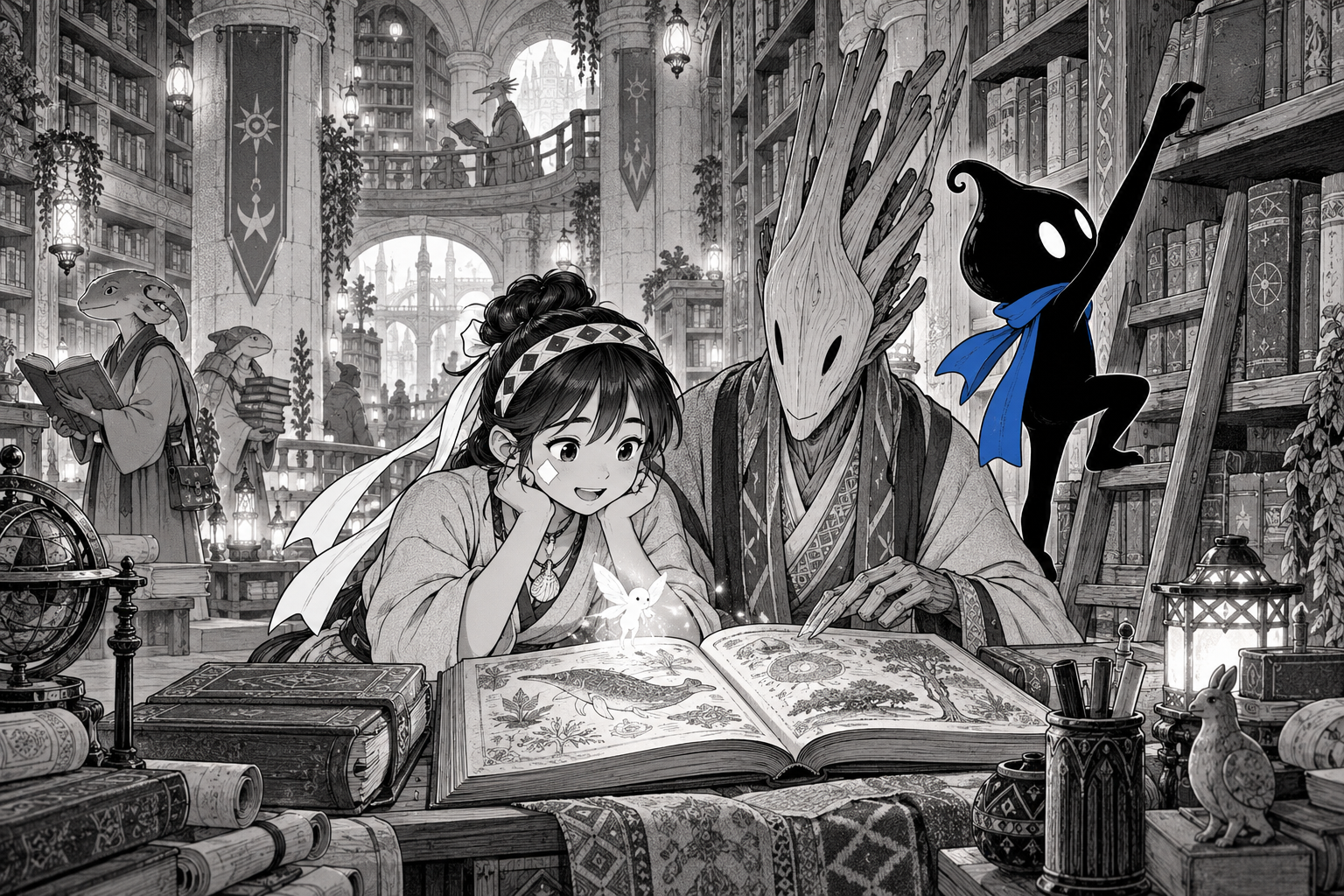
Ink has been studied for centuries. The protagonists' ignorance is personal, not universal. Educated households can read histories, guilds teach practical knowledge, and scholars disagree in public. Scarce temporal coordinates do not make ordinary Ink biology a lost secret.
| Book or record | Keeper and contents | Useful scene |
|---|---|---|
| Field Book of Stilling | Patrol handbook comparing dangerous forms, contact patterns and retreat signs. | A captain identifies a threat before Meok does; a marginal note shows a local exception. |
| Quiet Well Register | Nursery keepers' observed births, source currents and individual development. | Compare healthy births with a military claim that Ink are all malformed weapons. |
| Oru's Lamp Ledger | Signed route decisions and names of households beyond the closed branch. | A beloved founder's actual cost appears beside a later celebratory account. |
| Three Wardens Commentaries | Iseul, Haran and Daru's competing teachings, with dated later editions. | One school quotes a line whose next sentence another edition preserves. |
| Return Fields Arrival Rolls | Ward stations' dates, drawings, scars and recovered human objects. | Match Hu's mark and the old recovery order to a creature that has only just arrived. |
| Book of the Last Bell | Sacred history, charity duties and the official Hu/Sumbi narrative. | A sincere healer uses it to help a stranger while a superior uses it to claim Sumbi. |
| The Letters We Kept | Ink-authored testimony about ordinary lives, captivity and chosen violence. | An Ink writer disputes both romantic innocence and the claim of collective evil. |
| Plate Mender's Cases | Failure diagrams, mana depletion, injury records and repair methods. | The worn suit in front of them has a known failure mode, not an unexplained power loss. |
Older records need not be wholly right, and later books need not be wholly false. A source has an author, purpose, date and access to evidence. Research should produce a choice: whom to believe, what risk to take, which institution to confront or what record to protect. No single convenient book explains every mystery.
Places a writer can use
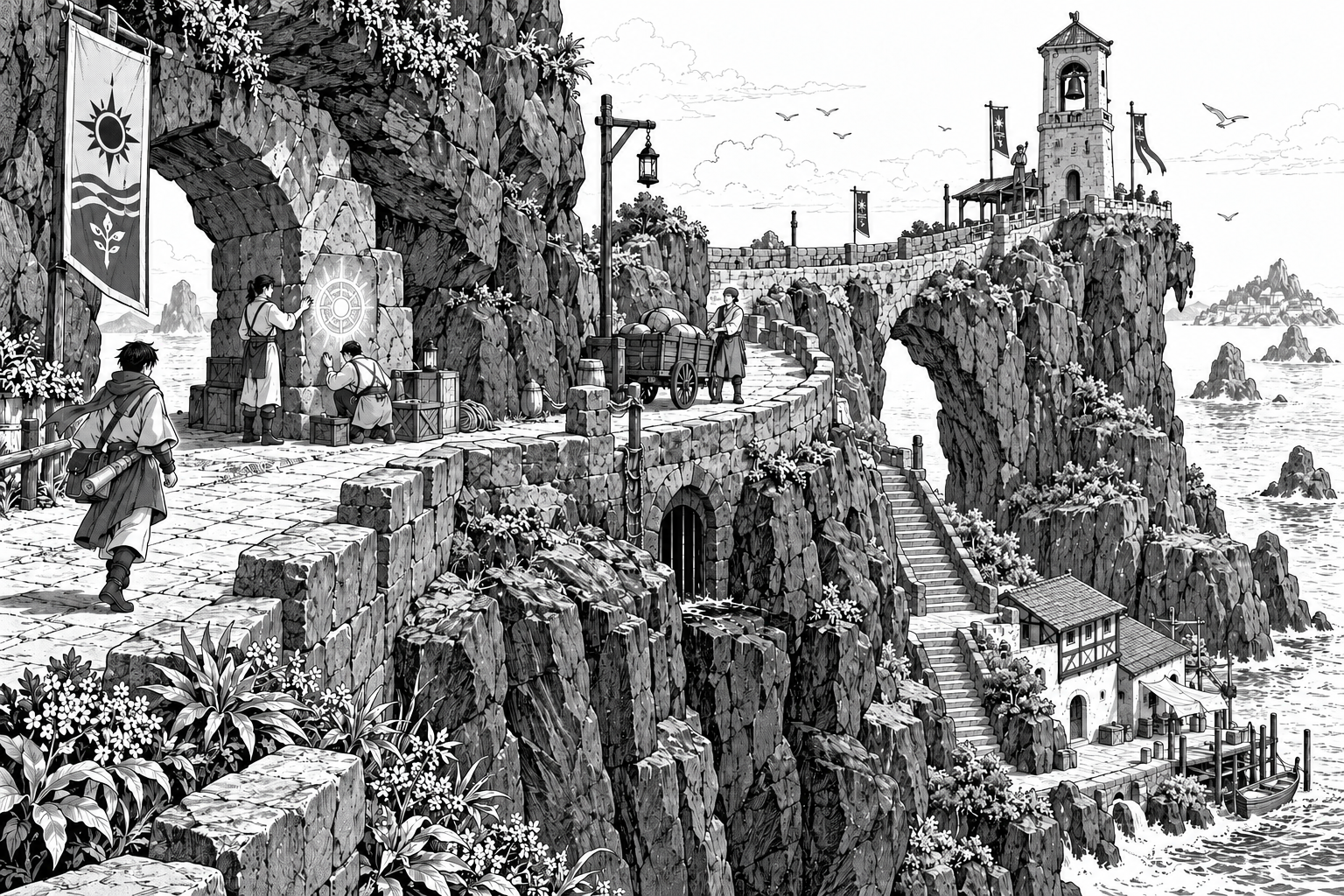 Human coast · Bell Steps
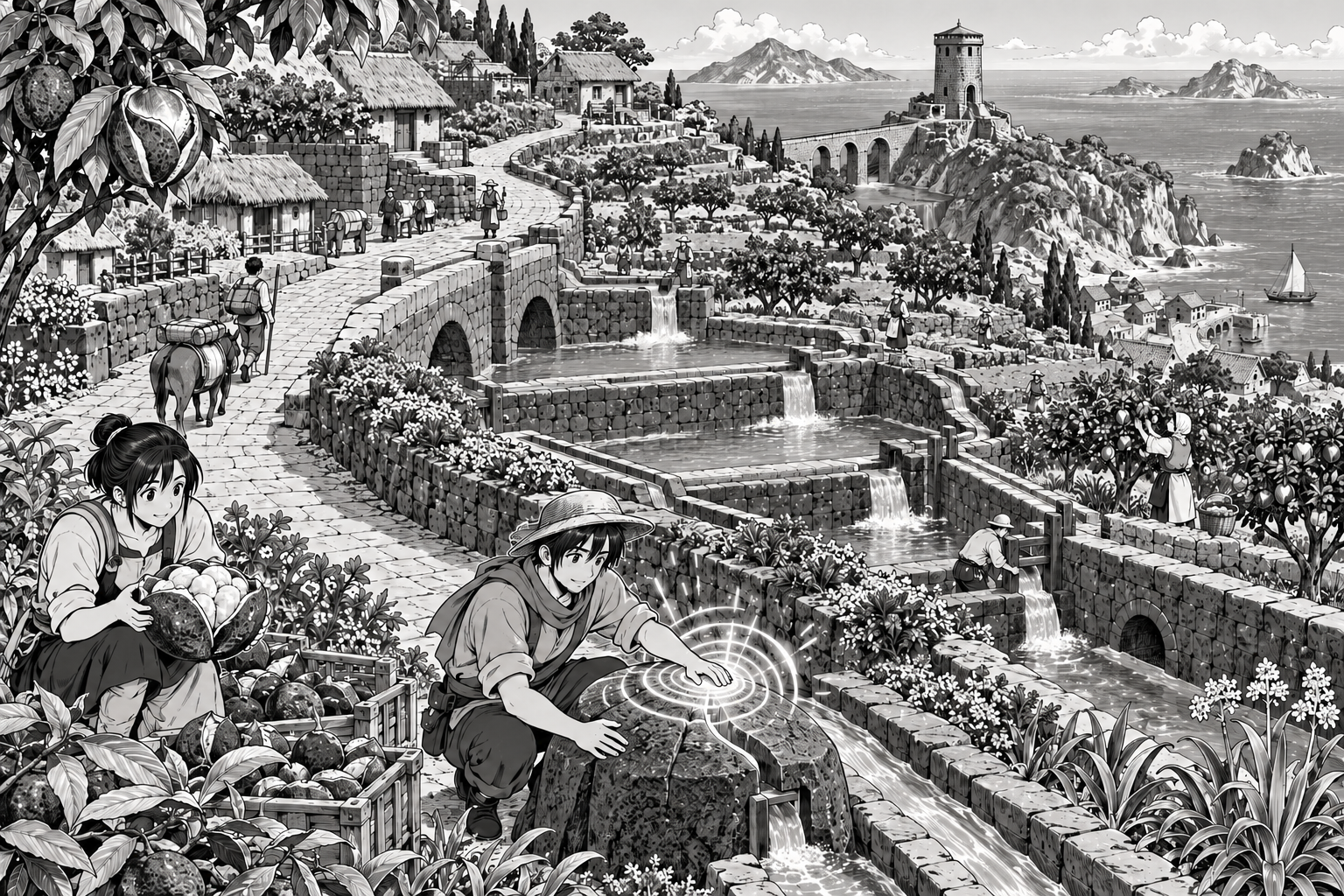 Human coast · Spring Terraces
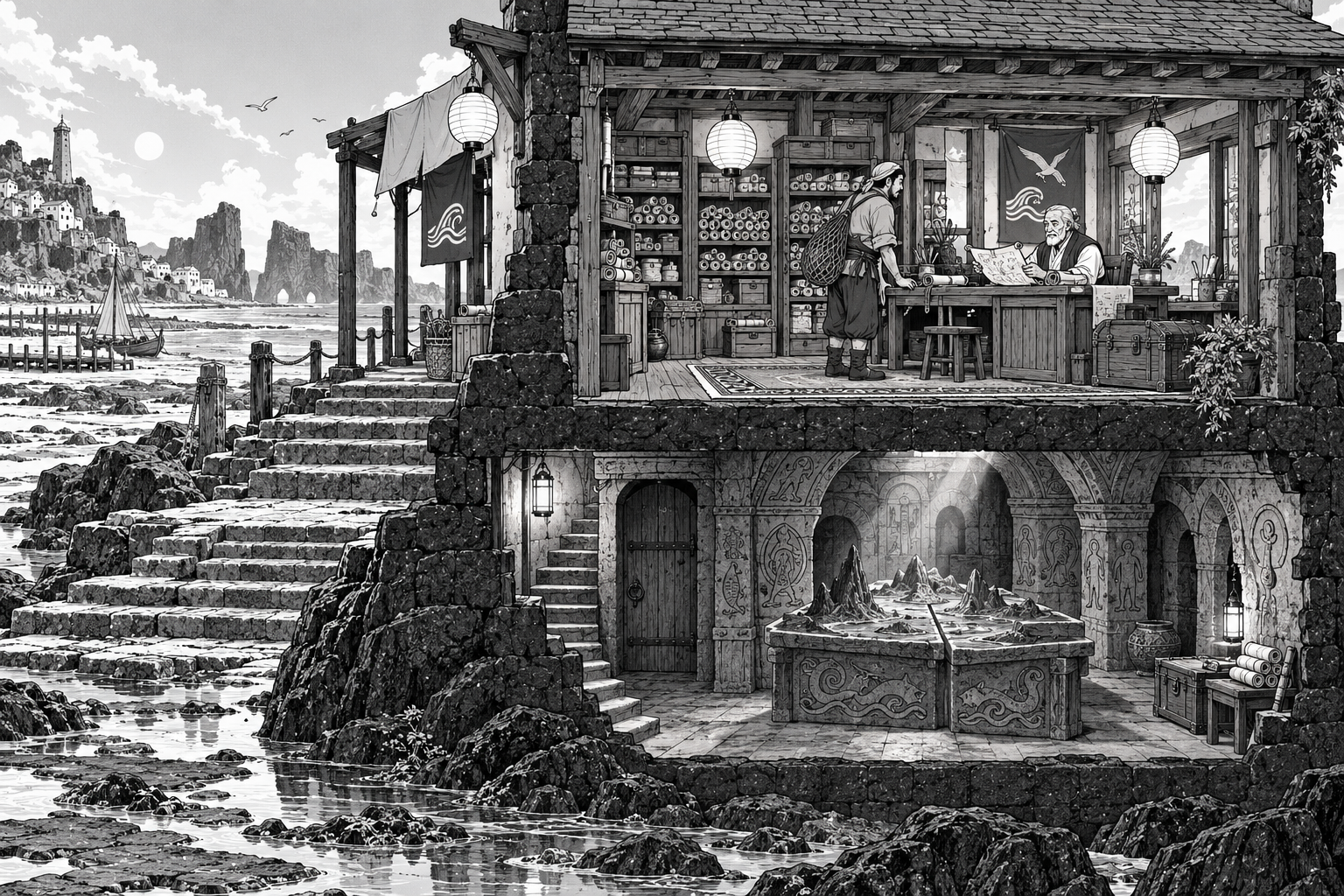 Human coast · Tide Archive
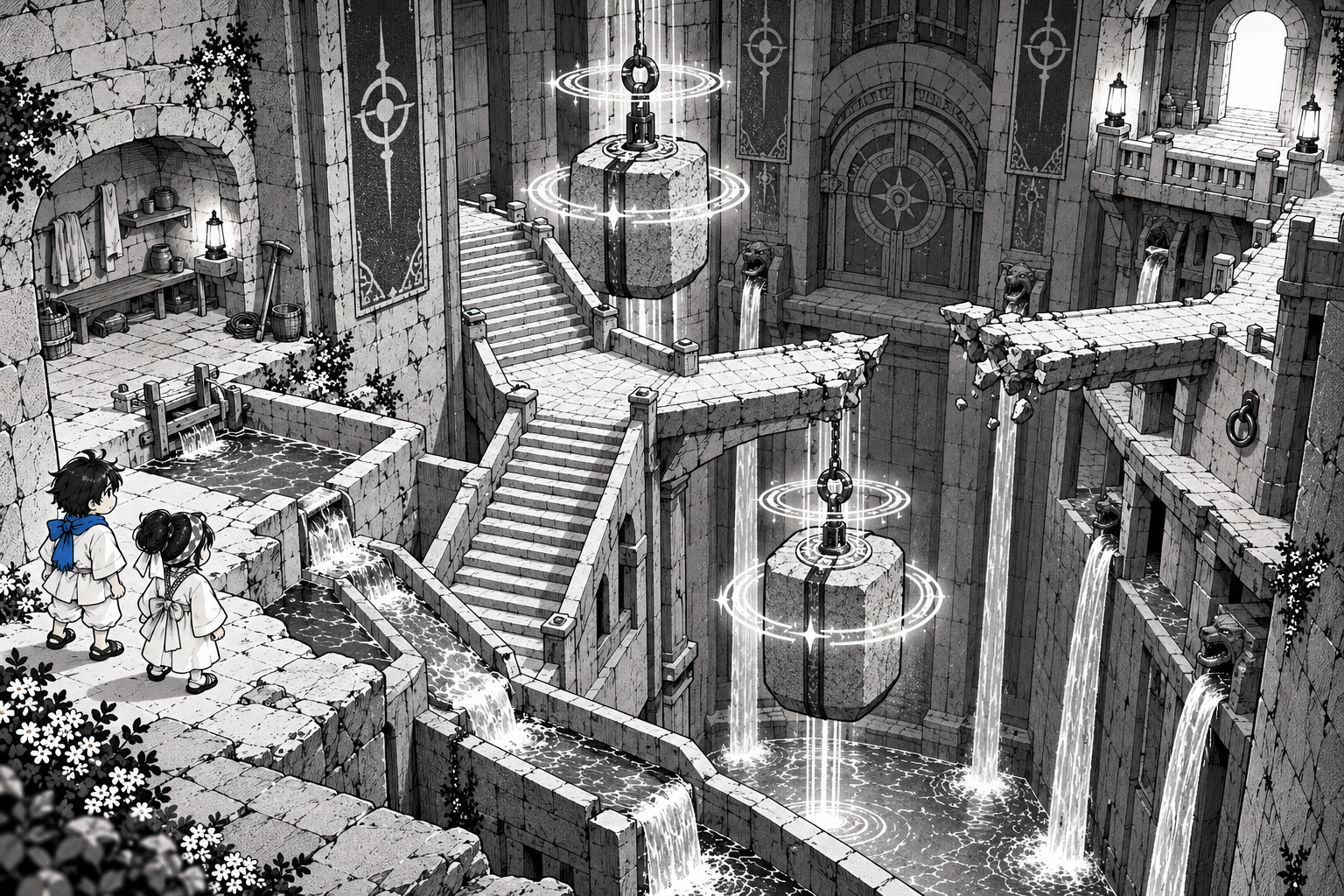 Other world · Counterweight House
| Place | Ordinary life | Wonder or pressure |
|---|---|---|
| Home harbour | Divers mend nets, children compete, families share meals. | Watch bells interrupt a peaceful afternoon; a missing answering bell matters. |
| Bell Steps | Nari carries messages between watchposts. | Tuned bells relay sound through stone; someone can interrupt the sequence. |
| Spring Terraces | Shared water supports basalt orchards and household work. | Fruit opens to a practised tapping rhythm; a missing spring threatens income. |
| Tide Archive | An archivist preserves attack records and disputed relics. | Its path opens at low tide and a storm can isolate the keeper. |
| Lantern Exchange | Nonhuman families trade, eat, repair ward plates and argue. | White lamps remember safe paths through shifting terraces. |
| Counterweight House | Menders maintain route machinery and its seals. | A failed weight shifts access to a gate; the mechanism preserves a historical choice. |
| Echo Basin | People collect wash-up objects and listen for familiar voices. | Speech residue crosses here; a repeated sentence is evidence, not automatically a conscious ghost. |
| Quiet Wells | Ink nurseries exist beyond ordinary patrol routes. | The surface holds unexpressed words; a core can form where currents settle. |
| Return Fields | Ward stations protect nearby settlements. | Living war forms arrive through dated return matrices; their scars identify distant battles. |
| Last Bell sanctuary | Healers feed travellers and maintain public wards. | Its hospitality becomes coercion when Sumbi is claimed as the promised Witness. |
The Founders versions show these places being built and argued over. The Ward Age shows their maintenance and ordinary use. The Consecrated Age shows accumulated institutions, changed customs and contested memory. Reuse recognisable geography and give each era distinct wear, dress and ownership; do not substitute a disconnected new environment every chapter.
Cast and writing behaviour
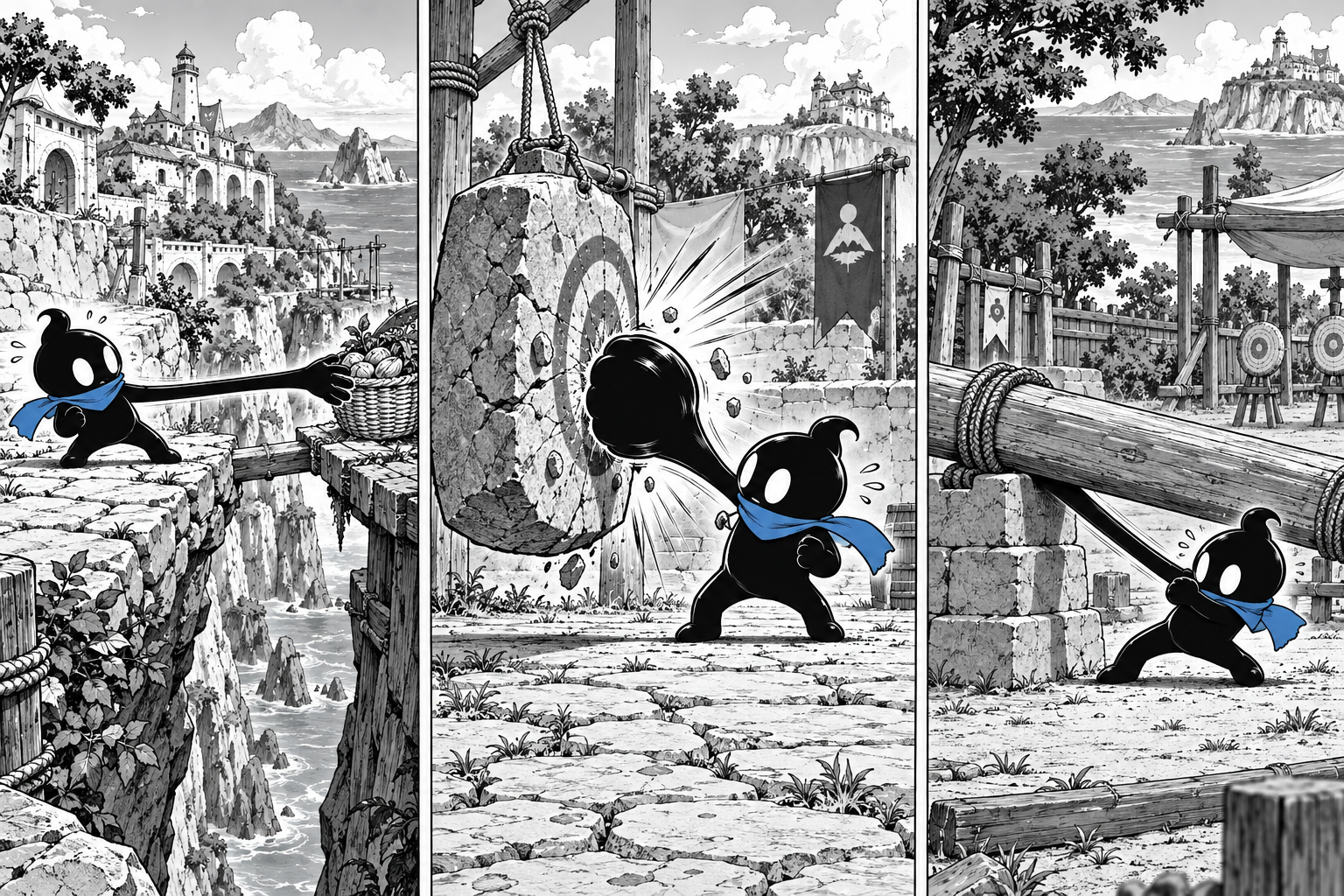 Meok · reach, weight and commitment
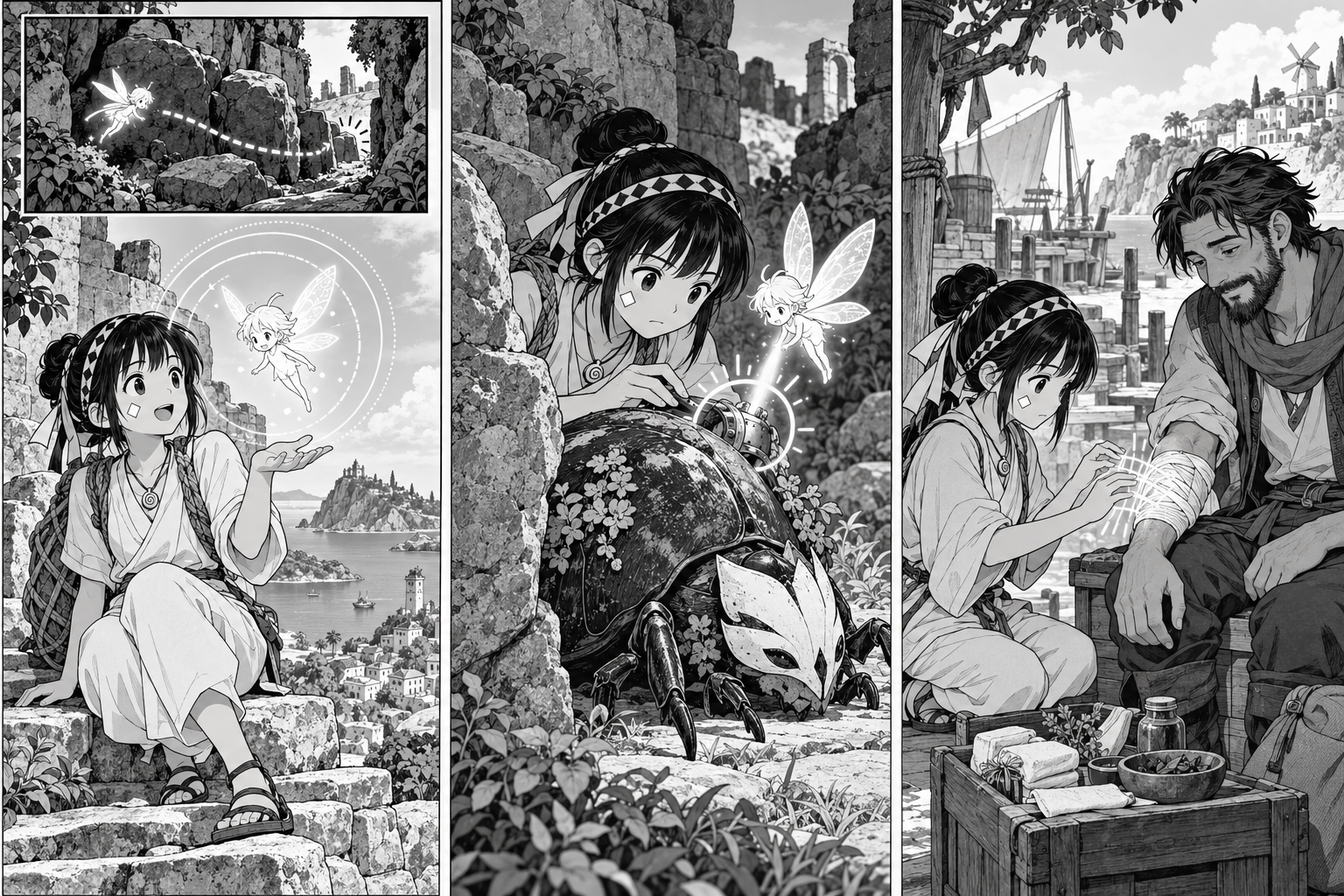 Sumbi · sight, weakness and support
Meok: acts bravely when somebody needs him, but can be anxious about what his body reveals. His humour includes competitive games, practical stretching and trying to pass off tastes he cannot experience. His core desire is to become human and belong. His dangerous flaw is accepting a costly promise of normality or trying to prove he deserves acceptance. His belief is that a corrupted person deserves a chance to recover. Growth means learning the difference between offering a chance and promising a cure he cannot deliver.
His fighting starts with attached reach, enlarged hands, pulls, guards and weight committed to a strike. A stretched limb can be pinned or cut off from leverage. A heavy attack has recovery. Returning Circle is a physical loop of his body, distinct from Hu's sealing brush. Unbinding develops through difficult contact and can destabilise his core; it never replaces combat timing and judgment.
Sumbi: wants a splendid view, a contest she can win and a day that belongs to her. Her sea-diver mother forbids diving because it is dangerous, rather than secretly training her for sacrifice. Ghosts intrude on Sumbi's day; she starts by helping them so they will leave her alone. She can practise patiently and observe carefully. She becomes stubborn when attached to her first explanation, rather than being rash in every scene.
Her belief is that helping the living must not mean owning the dead. Her blind spot is becoming attached to a spirit she ought to release. She supports actively: choosing the scout route, interpreting a weakness, steadying Meok or treating an injury. She does not serve as a passive camera or endlessly available healing reserve. Her fairy is a willing companion with curiosity, preferences and fatigue; consent matters in their magic.
Their arguments: small friction comes from Sumbi's competitions, Meok pretending to enjoy a flavour and conflicting ideas about taking a shortcut. Bigger friction comes from Meok delaying a necessary retreat to restore an attacker, or Sumbi insisting a bound spirit be released while people still depend on its ward. Let both notice something true. Follow disagreements with practical care, not an apology that erases the cost.
Hu: a competent wartime protector and loving grandfather. He uses inherited return craft without knowing its temporal destinations. He tries a supervised restoration once, respects Meok's refusal, prepares containment and leaves Dol the watch and records. He also leaves a real burden in other eras. Do not turn him into either a negligent old man or an innocent whose consequences never matter.
Halmang: practical, warm and blunt. She finds a living child, gives him a home and keeps caring through frightening facts. Her folklore can be incomplete without making her foolish. Dol is the trained successor who acts when danger reaches the village. Nari is the human bell courier; she does not become an earlier human resident of the other world.
Moru: a Reedkin seed keeper and guide with a home and livelihood to protect. He knows routes and local customs, not every answer in the bible. Talu: a Kilnfolk apprentice mender whose faith initially supports the Last Bell institution; helping Meok rescue Sumbi forces Talu to oppose coercion without abandoning care for the town. Talu joins the party during the future confinement arc.
Oru: the refuge builder who closes a branch while people are still outside. Iseul: the protector who closes attack roads. Haran: the Warden who insists rescue must come first. Daru: the Warden who preserves command records as a defence. The last three agree that war must end but disagree about what safety permits. They are people with friendship, jokes and bad decisions before they become competing schools and monuments.
Sae: an Ink whose human-form experiment became the First Mask legend. The actual sender and rescuer of Meok. The attempt granted a convincing form, not a human soul or complete human senses. Sae's freely chosen rescue matters more than the legend's argument about purity.
Seo: the future Choir leader who believes a world that calls Ink demons will never voluntarily free them. Offers belonging and recognises real injustice. He takes away the freedom to refuse his cause. Ryeon: the long-lived Ink commander who carries command methods across the cradle route and later becomes Seo's right hand. He is the Chapter 1 stamp-holder. His preference for control, his own imposed form and his refusal to risk freedom drive his choices.
Protection and the world's appearance
Mana-fed plates resist weaker petrifying binding Ink. Stronger demons can breach an intact, fully charged ward. Contact spends protection; broken channels create local gaps; fatigue dims the ward. Physical repair and mana replenishment are different tasks. Armour does not cure stone victims or cancel a stretchy punch.
Engraved channels, replaceable plates and visible maintenance make this a shared craft across the local peoples. Guards have full fittings, couriers carry lighter pieces and craftspeople adapt protection to their work. Preserve different faces, silhouettes, bodies and materials. Everyone should look like they inhabit a culture accustomed to danger, not like one repeated soldier model.
Reedkin have pale wood faces, grouped carved features, roots and layered leaves. Moru's three short vertical facial marks are a grove identity, not a corruption mark. Kilnfolk have articulated fired-clay bodies and repairable seams. Tidekin have webbed hands, translucent fin crests and layered clothing. Their mana channels keep them alive, so petrification can arrest ceramic, wood or mineral life as well as flesh.
Hostile binding marks are angular broken command strokes. Personal grove marks, intact ward channels, Court ownership stamps and the rescuer's damaged mark are different systems. A friendly wooden guide must be recognisable beside a hostile root creature without relying on dialogue to distinguish them.
Working twenty four chapter spine
Protect the friendship; discover exclusion
Earn the way home; meet living legends
Witness choices; meet their consequences
A warm welcome becomes a demand
Find allies and the rite’s mechanism
Build an alternative; return changed
This is an author planning spine, not approval of new manga pages or a prescription for game levels. Chapter 1 is protected. Each later chapter needs an immediate desire, opposition, a consequential choice, an outcome and a changed next problem. Let discoveries emerge through events rather than explanations of the whole bible.
| Chapter | Immediate story and change |
|---|---|
| 01 | Approved Chapter 1: family, war aftermath, Hu's legacy and Sumbi's deliberate late discovery that Meok is Ink. |
| 02 | Investigate the missing spring; the fairy activates the water threshold. Both cross into the Ward Age and cannot immediately reopen it. White lamps offer a route. |
| 03 | Meok saves a local during a minor Ink attack; a checkpoint ward catches him too. Sumbi is welcomed while he is excluded. |
| 04 | Moru helps them reach Counterweight House. Sumbi's shared sight exposes an actual route and Meok commits to an inventive fight. |
| 05 | Restore the marked home anchor and help someone the defenders had written off. They return after several real days, with limited trust and a reason to come back. |
| 06 | Home consequences: mother's fear, the watch's responsibilities and Nari learning the truth. The shell is identified as otherworld material. |
| 07 | Follow the Hearth pair into the Founders Age. Meet Oru and the Wardens before their reputations hardened. |
| 08 | Find the Quiet Wells and an independent Ink life. Halmang's story begins to look incomplete. |
| 09 | A threatened branch forces Oru's refuge decision. Sumbi holds an evacuation crossing and leaves alive, creating the event later called martyrdom. |
| 10 | The Wardens fracture over rescue, closure and retained commands. An apparent technical safeguard becomes a future source of coercion. |
| 11 | Return to the Ward Age and compare a remembered event with the record. Meok and Sumbi disagree about what should be preserved or exposed. |
| 12 | The Bell pair reaches the Consecrated Age. A creature bearing Hu's brush scar connects his old victory to a newly experienced disaster. |
| 13 | The Last Bell sanctuary welcomes Sumbi as its Witness. Meok discovers Hu's condemned name and his own depiction as a demon. |
| 14 | A restoration attempt costs Meok stability. His longing for human senses becomes a private vulnerability the Choir can exploit. |
| 15 | Ryeon recognises him. The vessel rescue and Sae's role acquire an author-chosen explanation rather than another unrelated twist. |
| 16 | The sanctuary confines Sumbi through care, pressure and wards. Meok must accept help from Talu instead of solving everything through force. |
| 17 | Talu helps them escape and loses institutional safety. Genuine believers disagree about coercion; charity is not erased by exposing the rite. |
| 18 | A Choir alteration overwhelms familiar armour and ward tactics. The pair must adapt their strengths instead of receiving an unexplained stronger spell. |
| 19 | Return to the nursery records and complete the Ink-origin revelation. Meok learns what an open core makes possible and what it can destroy. |
| 20 | Establish the rite's actual mechanism: enforced cheap stability, not a divine need for Sumbi to die. A voluntary alternative has a public cost. |
| 21 | Make a coalition of menders, residents and independent Ink. People choose greater personal mana and repair burdens rather than ownership of a permanent victim. |
| 22 | Confront Ryeon at the command controls. Combat, revealed weaknesses and bounded unbinding work together; some injuries and losses cannot be undone. |
| 23 | Break coercive ownership while retaining workable protection. Ryeon is restrained without his command authority; Seo escapes with followers and remains a recurring enemy. |
| 24 | Return home changed. Meok declines a conversion that would close his open core; the human wish remains emotionally real. Sumbi refuses a destiny others wrote for her. New ordinary obligations and unresolved faction conflict leave the world alive. |
The ending is a working author answer. Meok chooses a life he values rather than being shamed into owing his body to everyone he could help. Sumbi's refusal does not magically abolish all religion or remove every danger. The coalition pays for its alternative through mana, labour, risk and continued defence.
Before a chapter draft leaves the writer
- Record the world, era, physical anchor and elapsed home time for every crossing. Reverse travel uses the same pair; no arbitrary year selection appears to solve a scene.
- Record what Sumbi, Meok and the viewpoint character know. Author knowledge cannot become dialogue without a source or discovery.
- Preserve Chapter 1's living-before-rescue Meok, safe ordinary touch, dry-quay rescue, shell shelter, Halmang dive and late Sumbi reveal.
- Give each fight a readable opponent, intention, distance, opening, cost and aftermath. Marked corruption, natural predation and chosen cruelty are different causes.
- Show a magical effect's source, target, visible action and limit. Shared sight is not mind reading; a revealed weakness still requires action; healing does not erase command bindings or death.
- Keep a person's desire, belief, secret and cost active. Neither lead is rash in every scene, and support does not make Sumbi passive.
- Let humour, food, competitions, trades and beauty exist alongside danger. A chapter about a world should contain someone enjoying living in it.
- A future religious claim must be tracked as belief, evidence, manipulation or author truth. “Destiny” is never a substitute for a causal mechanism.
- Do not restore old prototype rules or weak later chapter events merely because an archived file contains them. Current bible and approved chapter pages govern.
Reference and revision order
- 1OwnerLatest direction
- 2Approved pagesChapter 1 and entrance
- 3Current bibleAnswered author reference
- 4Character packetWhere compatible
- 5ArchiveEarlier explorations
The owner’s latest directions take precedence. Approved Chapter 1 pages and the liked entrance constrain staging. Design/World/World_Direction_20261012.json records accepted world choices. This bible and Design/World/Writer_Questions_Answered_20261012.json supply explicit working author answers. The character packet supplies scene behaviour where compatible; its old physical-underworld destiny and undecided options do not override this edition.
Game mechanics, numerical balance and level design remain with the owner. Art follows agreed scene descriptions. This bible can support writing immediately while keeping new author choices visible for revision.
Visual and prose continuity
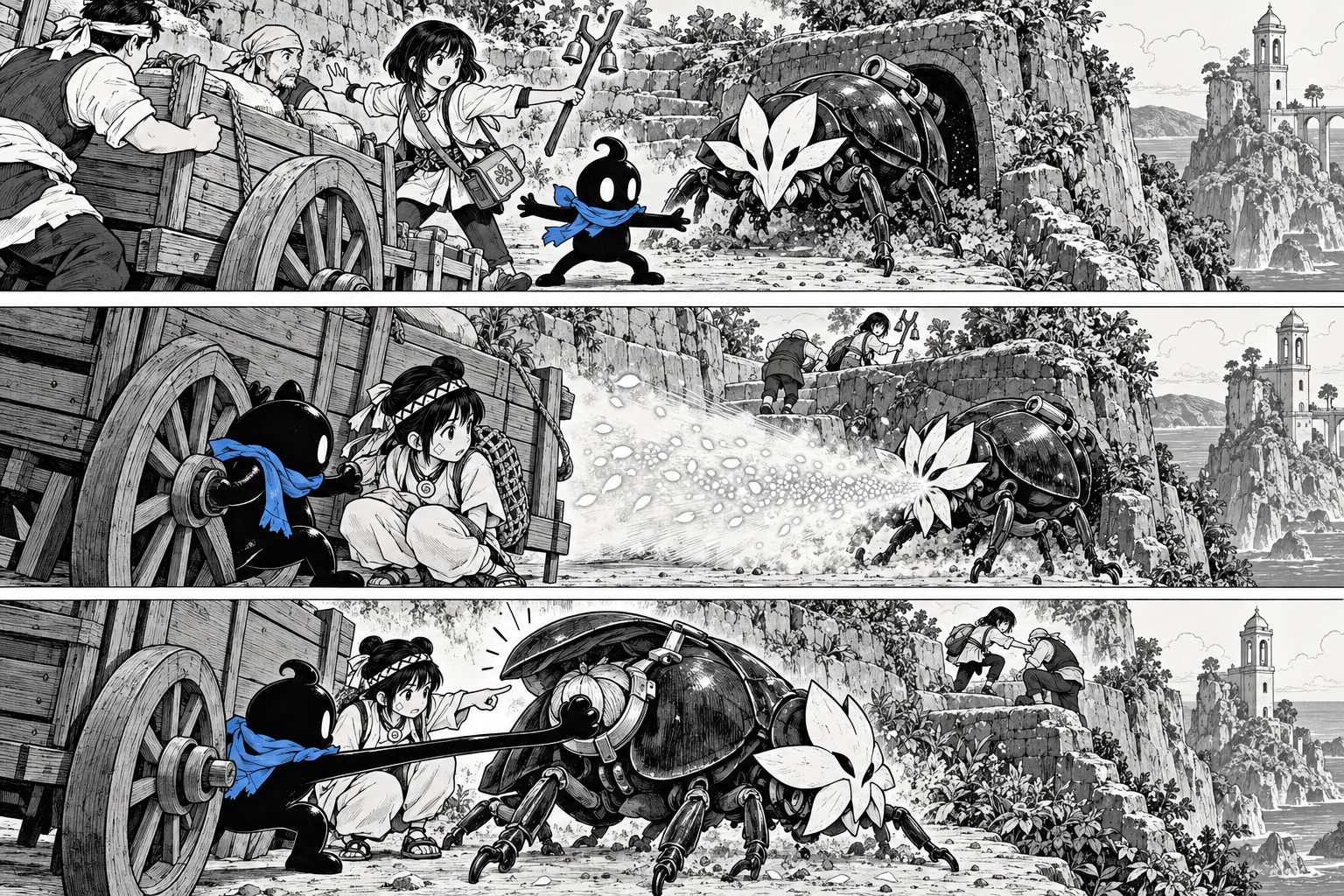
Keep the established drawn manga style: clear contours, controlled grey tones, expressive faces, readable stone, wood, cloth and action. Meok's blue scarf remains an identifying accent. Magic needs visible casting, contact, channels or a changed state; a vague invisible effect is insufficient.
The human coast keeps its island work clothes and fantasy period silhouettes. The other world's future develops its magical crafts and institutions rather than automatically becoming a modern city of cars and phones. Armour fitting, repair marks, lamp design and different uses of old buildings distinguish eras while retaining recognisable places.
New illustrations follow a specific scene description accepted before drawing. Existing concept art supplies atmosphere where it does not depict the newly answered event; captions should say so. Do not silently change approved frames to make an author answer appear already established.